
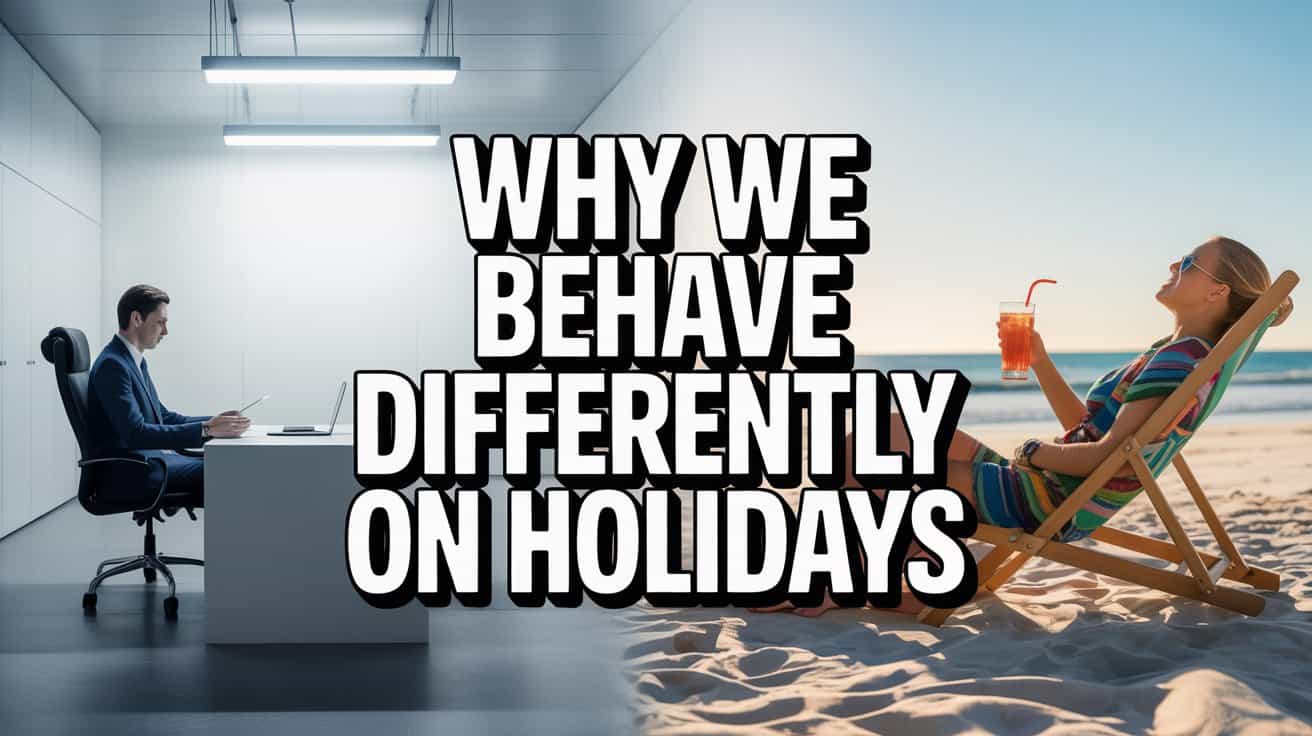
Why We Behave Differently on Holidays
(And What Travel Reveals About Us)
Have you ever noticed how you become a slightly different version of yourself the moment you leave home?
Not dramatically different. Just shifted.
You eat things you would never order at home. You talk to strangers in airport lounges.
You wear colours you don’t usually choose. You stay up later. You spend more. You forgive more easily.
And sometimes you say things you’ve been holding back for months.
It’s something many travellers experience but rarely stop to think about why we behave differently on holidays.
After years of travelling and observing people on cruise ships, in airports, and in hotel breakfast rooms around the world, I’ve come to believe that holidays don’t just change our environment.
They change our behaviour often in subtle but revealing ways.
The Freedom of Being Unknown While Travelling
One of the most powerful psychological shifts that happens during travel is anonymity.
At home, people know your role. Your job. Your responsibilities. Your routines.
When you travel, those labels disappear. Nobody knows your history, your reputation, or what people expect from you. Suddenly you are not the reliable one, the organised one, or the one responsible for everything.
You are simply a traveller. And that small shift creates a surprising sense of freedom.
Psychologists sometimes refer to this as the “vacation effect.” Novelty stimulates the brain and increases dopamine, which can make us more open, curious, and willing to try new things.
But science aside, I’ve watched it happen in real life many times. Couples who barely speak at home spend hours talking over dinner. Shy travellers suddenly become the most engaging person at the table. Geography really can change behaviour.
A Small Moment That Explained Travel Psychology
I remember being on Ovation of the Seas cruising from Papeete to Sydney.
We had sailed on that ship several times before, so I knew where to find the quieter corners something very useful on a ship carrying around 5,000 guests.
One afternoon I needed some quiet time and wandered to a peaceful space above the 270 Lounge. It’s slightly hidden but overlooks the activity below. Comfortable armchairs, calm décor, and just enough distance from the crowd.
Perfect for reading. Or so I thought.
A man sat down nearby and started talking to me. Not exactly what I had planned, but he was warm and engaging, telling me about the many cruises he had taken and why he loved this ship so much.
He was travelling solo for the first time. His wife, he said quietly, had always loved spending time in that exact spot.
I never saw him again for the rest of the voyage. But in that brief conversation, he opened up in a way people often do while travelling sharing memories and emotions with someone they had only just met.
Travel creates those small, unexpected moments where people feel safe enough to reveal more of themselves.
Does Travel Change Who We Are?
Or does it simply reveal who we already are?
The more I observe travellers, the more I believe holidays don’t really change us.
They expose us. When the alarm clock disappears, when the inbox goes quiet, when nobody needs you to solve problems for a few days, something in the body relaxes. The nervous system softens. The shoulders drop. The mind stops scanning for the next task.
And in that space, a different version of ourselves begins to appear. Sometimes lighter. Sometimes more playful. Sometimes unexpectedly emotional.
I’ve seen people cry watching sunsets who would never describe themselves as sentimental.
My husband was one of them. We were sitting at sunrise overlooking Angkor Wat in Cambodia. Thousands of people stood silently as the sun slowly rose behind the temple towers. It was breathtaking. And yes emotional.
Travel has a way of doing that.
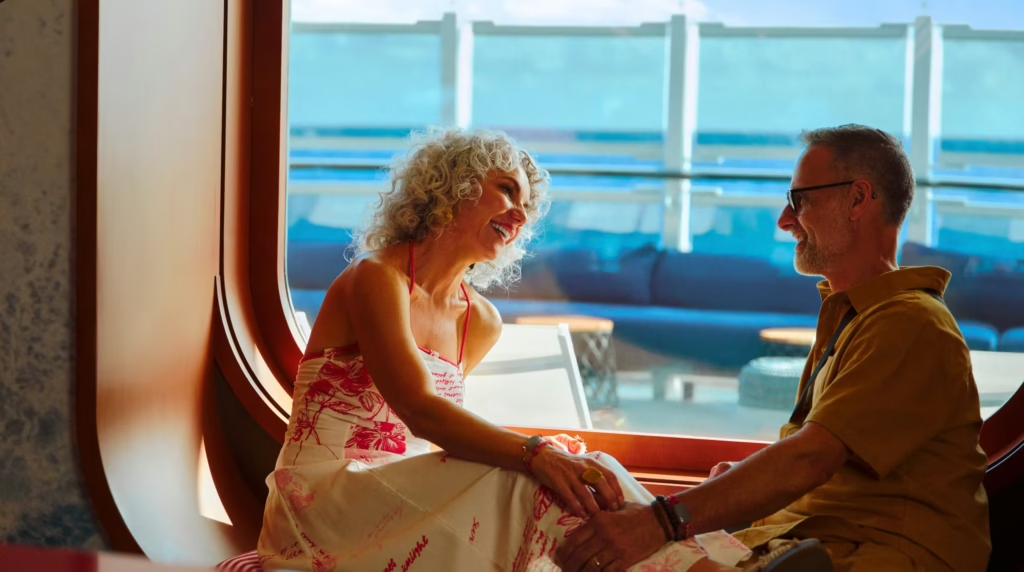
The Science Behind Why Travel Changes Behaviour
There is a neurological reason why we behave differently on holidays.
New environments stimulate the brain. Unfamiliar sounds, languages, smells, and landscapes increase dopamine, heightening curiosity and awareness. The brain becomes more alert and more open to new experiences.
That’s why Food tastes stronger. Colours seem brighter. Conversations feel deeper. At home, routine protects us. Away from home, unpredictability expands us. And expansion often feels like freedom.
When Travel Reveals Relationship Cracks
Of course, travel doesn’t only amplify joy. Sometimes it magnifies cracks.
Couples argue on holidays not because the trip is wrong, but because expectations are so high. We assume travel should automatically make us happy. When it doesn’t, frustration has nowhere to hide.
Fatigue, constant decisions, and unfamiliar logistics strip away our usual coping mechanisms.
If communication is weak at home, it will likely feel even weaker in a different time zone.
As a slow traveller, I’ve met people from every corner of the travel world backpackers, digital nomads, retirees, and luxury travellers.
Each one has a story.
Some young backpackers begin their journey with friends, full of excitement about the adventure ahead and the memories they will create together. But travel has a way of revealing differences that everyday life hides. One person wants to move quickly from place to place, chasing the next destination, while the other prefers to linger, absorbing the atmosphere. Some want nightlife and crowds; others want quiet cafés and early mornings. It doesn’t take long before they realise, they travel very differently, and many eventually find themselves seeking new companions who move through the world at a similar rhythm.
Others carry much heavier stories.
One woman I met in Vietnam told me a story that has stayed with me ever since.
She and her husband had been travelling together for several months. On the surface it looked like the kind of adventure many couples dream about leaving routines behind, exploring new countries, and finally having time together after years of work and responsibilities.
Then one day, completely out of the blue, he told her he no longer wanted their life together. After twenty-three years of marriage, he said he wanted something different.
She was stunned. There had been no big arguments, no obvious warning signs that she could see. One moment they were travelling together, planning the next part of their journey, and the next he had decided to leave.
He went to Thailand to begin a new chapter for himself. She stayed in Vietnam, trying to process what had just happened.
What struck me most when she told the story was the quiet strength she showed in that moment. She wasn’t dramatic or angry when she spoke about it just deeply hurt and trying to make sense of something she had never expected.
Travel hadn’t created that fracture.
But the intensity of being away from home the long days together, the unfamiliar surroundings, the removal of normal routines had brought something to the surface that might otherwise have remained hidden for much longer.
Travel doesn’t always create tension. Sometimes it simply reveals it.
Why Coming Home Feels Strange After Travel
Coming home after travel can feel surprisingly disorienting. The same kitchen. The same street.
The same responsibilities waiting patiently where you left them.
For some people there is relief in that familiarity. A comfortable return to routine, favourite foods, and the rhythm of everyday life.
But for others and I include myself in this there is often something else as well. A quiet restlessness.
I suffer from what I jokingly call Post Travel Depression, although for me the feeling is very real. It’s not sadness exactly. It’s more like a subtle emotional drop after the intensity of being away.
While travelling, every day carries a sense of discovery. New streets, new conversations, new flavours, new landscapes. Even the smallest moments feel heightened because everything is unfamiliar.
Then suddenly you are home again. The stimulation disappears. The novelty fades. Life returns to its normal patterns. And part of you feels like it has been gently compressed back into a smaller space.
It’s a strange sensation because nothing is actually wrong. Life is good. Home is comfortable. But your mind and senses have just spent days or weeks operating in a more curious, expanded state. It takes time for that shift to settle again.
I often find myself scrolling through photos, replaying small moments from the trip a conversation with someone I will probably never see again, a sunrise that felt unexpectedly emotional, or the simple pleasure of wandering through a place where nobody knew my name.
Those memories linger. Because once you have experienced a slightly expanded version of yourself, it is very difficult to forget.
Which leads to a bigger question.
Why do we wait for a plane ticket to give ourselves permission to relax? Why does it take distance for us to speak more honestly, try something new, or simply slow down?
Perhaps the person who appears while travelling isn’t temporary at all. Perhaps it is simply the version of us that everyday life keeps contained.
The Real Gift of Travel
Maybe the person you become on holidays isn’t a temporary version of you at all.
Maybe she is simply less edited. Less rushed. Less responsible for everyone else. Less confined by routine and expectation.
Travel quietly peels back the layers we accumulate in everyday life. It interrupts the script and reminds us that we are more than the person answering emails on a Tuesday morning or managing responsibilities.
We are also the people who laughs a little too loudly at dinner with strangers. The one who says yes to the unfamiliar dish. The one who pauses to watch the sunset instead of rushing past it.
Perhaps the real gift of travel does not escape. Perhaps it is recognition.
A gentle reminder that the freer, more curious, more open version of us was always there simply waiting for a little room to breathe.
And maybe the most meaningful journey isn’t always the one that takes us somewhere new. Maybe it’s the one that brings a truer version of ourselves quietly home.
About the Author:
Sheridan-Leigh is the passionate voice behind the MyLifestyle Blog, where life is celebrated with vibrant stories and insightful travel tips. With a deep love for slow travel, she believes in truly experiencing each destination, creating connections beyond the surface. Her blog is a blend of personal stories, expert advice, and a philosophy that life is for living to the fullest and is rich with opportunities for growth and adventure. Join Sheridan-Leigh as she shares her journey, inspiring others to embrace life, travel deeply, and live fully.
Below are some recent travels on an interactive map.
Alternatively, view the full interactive travel journey at MyLifestyle Travel Map
Click on a trip line to see images, posts, accommodation and travel information about the destinations.