

What If Something Goes Wrong?
Travel Fears We Don’t Talk About (But Definitely Should) Especially If You’re Over 50
Let’s Have a Little Heart-to-Heart, Shall We?
Travel is one of life’s greatest joys, whether it’s a long weekend in the wine country of the Napa Valley, a slow cruise through the South Pacific Islands, or an afternoon getting gloriously lost in the backstreets of Vietnam. But let’s be real for a moment: if you’re over 50, you’ve likely packed a bit more than your passport, travel snacks and comfy shoes. You’ve probably squeezed in a little something extra, nervous energy.
Because somewhere between our backpacker youth, our family adventures and our wiser, more well-prepared selves, that carefree “she’ll be right” attitude starts giving way to a new internal dialogue. A voice that pipes up just when you’re feeling adventurous and says things like:
- What if I fall over and twist an ankle on those cobblestones?
- What if my medication goes missing or, worse melts in this heat?
- What if I forget my phone PIN again and lock myself out for the third time this week?
- What if the food doesn’t agree with me or it’s all deep-fried and mysterious?
- What if I end up in a hotel with no lift and I’m stuck lugging my bag up four flights of stairs?
- What if I need the loo and can’t find one in time?
- What if I can’t keep up with the group and feel like I’m slowing everyone down?
Sound familiar?
You’re not being dramatic. You’re being thoughtful. Practical. Wise. And most importantly
You’re not alone.
Over the years, in my travels and chats with fellow adventurers of a certain age, I’ve seen these worries come up again and again. Not just as passing thoughts, but as the very things that stop people from booking that trip, saying yes to that tour, or stepping outside their comfort zone.
Honestly, that breaks my heart.
Because travel isn’t just for the young and sprightly. It’s for the curious, the seasoned, the wonderfully imperfect souls who want to see the world a little slower, a little deeper, and with a lot more appreciation.
So, in this article, we’re going to unpack those fears, not to dwell on them, but to gently shine a light on them. To say: “Yes, I see you. And yes, there are ways around this.”
Because your best travel years might still be ahead of you. You need to feel safe, supported, and a little bit brave.
Let’s take that next step together.
Let’s be honest, these fears are real, but so is our ability to laugh and plan our way through them. Just recently, while helping two friends plan their visit to Vietnam, we found ourselves deep in the Viator.com listings trying to choose activities that wouldn’t require mountain goat-level agility. Between the three of us, we’d had five knee replacements and two hips. One of us had a knee and a hip, another had two knees, and the third had gone the full trifecta two knees and a hip. No, we’re not old, we’ve just had a few parts upgraded.
But here’s the thing: we didn’t let it stop us. We picked tours with Viator.com with minimal stairs, scheduled in plenty of downtime (and decent coffee), and spent more time laughing than limping. And honestly? It was one of the best trips we’ve had.
8 Common Things That Keep Us Up the Night Before a Flight
1. What If I Get Sick or Need Medical Help
This one tops the list and for good reason. Whether it’s a dodgy tummy from a street food feast or something more serious, the thought of needing a doctor in a foreign country can be frightening.
Health Wobbles Happen—Even to the Most Prepared
Let’s be real, none of us plan to get sick while travelling, but it can happen. That’s why I always recommend doing a little research ahead of time to find the best local medical facility or dentist in the area you’re visiting. Trust me, it’s far less stressful to know where to go before you need to go.
Take this recent trip with my spare-parts travel crew as a perfect example. One of them came down with a raging earache, the kind that won’t let you sleep or think straight.
At midnight, we dashed to Vinmec International Hospital in Da Nang something we had pre-researched as being the best hospital in the city for tourists. And it lived up to its reputation. The emergency department was clean, calm, professional, and efficient. We were in, seen, treated, and out within an hour, antibiotics in hand. (Picture that happening in an Aussie emergency room on a Friday night. Those who know, know.
A follow-up visit with an ENT specialist two days later sealed the deal; she was cleared to fly home, ear fully intact, and we were all able to breathe a sigh of relief. The cost is Around $90 AUD for the emergency visit and $120 for the specialist. All completely claimable on travel insurance (SafetyWing) if you’ve got the right plan, of course.
It was a powerful reminder that a bit of pre-trip planning goes a long way. Knowing where to go when things go wrong makes all the difference not just for peace of mind, but for making sure small issues don’t turn into trip ruining disasters.
My Take:
Getting travel insurance (SafetyWing) doesn’t just mean ticking the cheapest option. Read the fine print. Make sure your existing health conditions are declared, and that hospital stays, meds, and emergency evacuation (yep, it’s a thing) are covered.
Carry a medical essentials pouch:
- Your prescriptions
- A short health summary
- Painkillers, antiseptic cream, Imodium (you know why), and rehydration salts
- A printed copy of your travel insurance policy
And remember: most countries, especially in Asia and Europe, have excellent private hospitals. You may even find they’re faster and friendlier than back home.
2. What If I am Afraid of Flying?
Let’s not sugar-coat it being scared of flying isn’t just for nervous first-timers or Hollywood movie characters gripping the armrests. Plenty of seasoned, well-travelled adults still feel a rush of anxiety the moment the cabin doors close and the wheels lift off the ground.
And for some that fear gets worse with age not better.
Whether it’s a fear of crashing (thanks, imagination), turbulence, enclosed spaces, or just not being in control, it can cast a shadow over even the most exciting holiday plans.
Sheridan’s Sky-High Truth:
Yes, I’ve felt that tight chest and those sweaty palms on take-off. I’ve gripped David’s hand hard enough to cut off circulation (he’s fine now). And I’ve sat through a bumpy flight silently planning how I’d survive on a remote island if we “had to land” early.
But here’s what helps and it’s not just deep breathing and pretending to enjoy the safety demonstration:
My Tips for Calming Flying Fears:
- Learn the facts. Commercial air travel is one of the safest modes of transport. Turbulence might feel dramatic, but it’s normal and pilots handle it daily like clockwork.
- Pre-select your seat. I go for aisle seats near the wing it’s the most stable part of the plane, and I feel better being able to get up and move.
- Avoid caffeine and alcohol before flying (tempting, I know) they can increase anxiety and dehydration. Stick to water and maybe a peppermint tea.
- Distraction is magic. Load up your favourite feel-good shows, podcasts, or calming music. I have a go-to playlist.
- Consider speaking to your doctor. There’s no shame in asking for something to take the edge off especially for long-haul flights or if flying is stopping you from travelling altogether.
And Here’s the Bigger Truth:
The fear of flying is real but so is your strength. You’ve faced bigger things than this. And with the right tools and mindset, you can board that plane, breathe deeply, and find yourself landing somewhere extraordinary.
Remember: the sky isn’t the limit it’s the way there.
3. What If I Struggle with the Tech Stuff
Honestly, there was a time when all you needed to board a flight was a paper ticket and a sensible pair of shoes. Now? You need five apps, three QR codes, and the problem-solving skills of an IT specialist just to check in. And don’t even get me started on trying to scan your passport into an app that freezes halfway through your face ID.
So, what do I do? I do what any resourceful woman would: I call my adult son, who works in IT. And yes, the irony is thick. We’re the generation that raised these digital wizards, and now here we are, fumbling through airline portals and cursing why the confirm button won’t work.
Just click the little three dots, Mum, he says.
What three dots? I reply. I see no dots. I see doom.
The truth is that travel today has gone high-tech, and not always in a friendly, helpful way. You’ll need to navigate online bookings, e-visas, digital hotel keys, translation apps, and sometimes even ordering food through a QR code menu that disappears when your phone battery hits 12%. It’s frustrating, yes. But it’s also manageable with a little preparation and maybe a bit of help from the younger generation (who will absolutely roll their eyes but do it anyway).
Sheridan’s Simple Tech Survival Tips:
- Download everything before you leave the hotel: Wi-Fi tickets, maps, booking confirmations, and emergency contacts.
- Take screenshots of anything that might be tricky to reload on the go.
- Keep a small notebook with written down booking codes, addresses, and your son’s number (you’ll probably call him again).
- And print out backups because sometimes old-school is just better.
- Remember, it’s not about mastering every app, it’s about knowing enough to get where you’re going and being able to laugh at the rest.
Oh, the irony! We raised a generation of digital natives, but now we’re the ones fumbling with apps, QR codes, and airline check-in portals that require a PhD in patience.
4. What If I Get Scammed or Pickpocketed
A Little Story…
I once had a friend (who shall remain nameless) hand her phone to a friendly local in Bali, offering to take a photo, who promptly ran off with it. Another got distracted chatting with someone in a market in Thailand while their partner’s wallet magically disappeared from their zipped backpack.
We laugh about it now (mostly), but it’s a reminder that staying alert is key. You don’t have to be suspicious of everyone, but a healthy dose of street smarts goes a long way.
And above all, don’t let the fear of scams steal your joy. The world is filled with more kindness than crime. Be cautious, yes. But stay open-hearted too.
Street-Smart Tips for Keeping Your Money Safe:
- Wear your bag in front of you, not hanging off one shoulder or behind you. Cross-body is the best bonus point if it zips up and sits close to the body.
- Leave the diamonds at home. Flashy jewellery, big watches, or that designer handbag. They’re more of a please, rob me, sign than a fashion statement abroad.
- Use your hotel safe, yes, they’re not perfect, but they’re better than leaving things out in plain sight. Or buy a small portable travel safe.
- Split your funds. Never carry all your money and cards in one place. Keep a small amount in your wallet for day-to-day spending and stash a backup card somewhere separate (like inside your shoe bag, toiletries kit, or the hotel safe).
- Carry emergency cash. A small stash of AUD 100 or local currency, tucked away for just in case, can be a lifesaver if cards are lost, stolen, or suddenly declined.
- Trust your instincts. If something feels off, too pushy, too friendly, too good to be true, it probably is.
No one wants to come home with less than they left with, especially if it’s your wallet.
5. What If I Lose Access to My Money
(aka The Travel Nightmare You Didn’t Know You Should Be Scared Of)
You’ve finally arrived, ready to sip a coconut on the beach or buy that perfect handmade souvenir and suddenly your card gets declined. You try another ATM, nothing. You check your wallet your emergency cash is back at the hotel in the safe. Cue the mild panic.
Between card blocks, dodgy ATMs that eat your card for breakfast, and PINs that suddenly vanish from memory, this fear is more real than many travellers expect, especially if it’s been a while since your last overseas adventure.
This happened to one of my friends recently. She swiped her card at a boutique in Hoi An and bam, instant freeze by the bank. A potentially suspicious transaction triggered a block, and she spent the next 48 hours living off borrowed dong and banh mi until she could call the bank (also not an easy task if your phone does not receive the verification codes) and verify her identity.
Moral of the story? Your bank means well, but your holiday doesn’t need to be held hostage by fraud prevention systems.
Sheridan’s Tried-and-True Travel Money Tips:
- Let your bank know you’re travelling either through the app or by calling them. It only takes a minute, but it can prevent a world of stress.
- Set up a travel money card like Wise or Revolut. They’re easy to top up, let you hold multiple currencies, and often give better exchange rates than your regular bank.
- Carry at least two cards, ideally from different banks or providers. Keep one in your wallet and the other tucked safely in your suitcase or day pack. That way, if one fails, you’ve got a backup.
- Stash some emergency Aussie dollars enough for a night in a hotel, a basic meal, or transport back to the airport. Hide it well (but remember where you put it!).
- Photograph important documents your passport, cards, travel insurance, and emergency contact details. Store the images in a secure cloud service or password-protected note so you can access them even if your phone goes missing.
- Be ATM smart. Use ATMs attached to a bank during business hours. They’re less likely to be tampered with and more likely to help if something goes wrong.
A Little Preparedness = A Lot of Peace of Mind
Money dramas can derail an otherwise amazing trip, but with a bit of prep, you can avoid the worst of them. It’s not about being paranoid, it’s about having a plan B (and even a plan C) so you can focus on what really matters: the adventure, the memories, and maybe that third scoop of gelato.
6. What If I Feel Lonely or Out of Place?
This one’s big, and it’s more common than you might think.
Even with a full itinerary and a passport full of stamps, travel can bring moments of deep loneliness, especially if you’re travelling solo or spending extended time in one place.
Social media makes it look like everyone is having the time of their lives, clinking Aperol Spritzes with perfectly lit smiles, but the truth is, sometimes you’re just sitting alone at a café, feeling invisible, wondering why the waiter only smiled at the table of twenty-somethings next to you.
It can feel isolating, even when you’re surrounded by people.
But here’s the beautiful thing: connection is everywhere if you’re willing to look for it in the right places.
How I Stay Connected While Travelling
When my husband David and I decided to spend a period living in Vietnam, I knew I’d need more than just beautiful views and noodle bowls. I love his company, of course, but let’s be honest, sometimes you just need girlfriends.
So, we joined a few local groups. Together we volunteer at an English-speaking club, helping locals practise their conversational skills. It’s a weekly highlight, so much laughter, learning, and mutual appreciation. We also show up regularly at a friendly expat coffee club where the faces change, but the warm conversation doesn’t.
And I found an over-50s women’s group that meets for lunches, coffee catch-ups, and the occasional cooking or craft class. These aren’t just social outings, they’re soul food. There’s something incredibly comforting about sitting across from another woman your age, talking about shared experiences, joint replacements, or which local spa actually gives a proper massage.
7. What If I Can’t Keep Up?
This is a fear that quietly creeps in for many of us, especially after 50. We don’t often say it out loud, but it’s there.
- Will I be able to manage all the walking?
- What if the heat knocks me around?
- What if my body just says, “No thanks” halfway through the day?
And here’s the truth: you don’t need to keep up. You just need to know what works for you. That’s not weakness, it’s wisdom.
When David and I recently travelled to Cambodia, I knew the combination of tropical heat, uneven temple paths, and long days would eventually take a toll on my body. I’m all for adventure, but I’m also not interested in pushing myself to the point of exhaustion (or heatstroke).
So instead of signing up for an all-day, jam-packed itinerary like so many tourists do, I created my slow travel plan with the help of the Slow Travel GPT I’ve been developing. It’s my digital sidekick and planning genie that helps me tailor trips that suit my pace.
Here’s how we did it:
Mornings were for temples. We started early when the weather was cooler, and the crowds hadn’t yet descended. It meant we got to enjoy the ancient magic of Angkor Wat in peace, with the sun gently rising behind the ruins.
Afternoons were for rest. Back to the hotel for a swim, a nap, a fresh coconut, and that glorious feeling of putting your feet up without guilt. No racing around, no FOMO, just real, rejuvenating downtime.
Evenings were flexible. Once the sun dipped, we had the energy to head back out, maybe explore a local night market, grab a delicious Khmer dinner, or try something a little different like the pottery class I booked on Viator.com, which was a quiet highlight of the trip.
And here’s the real game changer:
We found the most kind, patient, and incredibly helpful local driver to stay with us for the entire time. His name is Cham (you can read more about him in my driver feature post here), and he truly made the difference. He knew when to suggest a shortcut, when we needed a break, and always had chilled water waiting. It was like having a caring local friend with wheels, and I can’t recommend this approach enough.
8. What If I Trip, Slip or Fall
Let’s face it, those charming cobblestone streets, ancient temple steps, and shiny tiled hotel floors might look beautiful in photos, but they’re not exactly mobility-friendly. Add in tropical rain, a bit of travel fatigue, and crowds of people rushing past, and suddenly the fear of falling becomes very real.
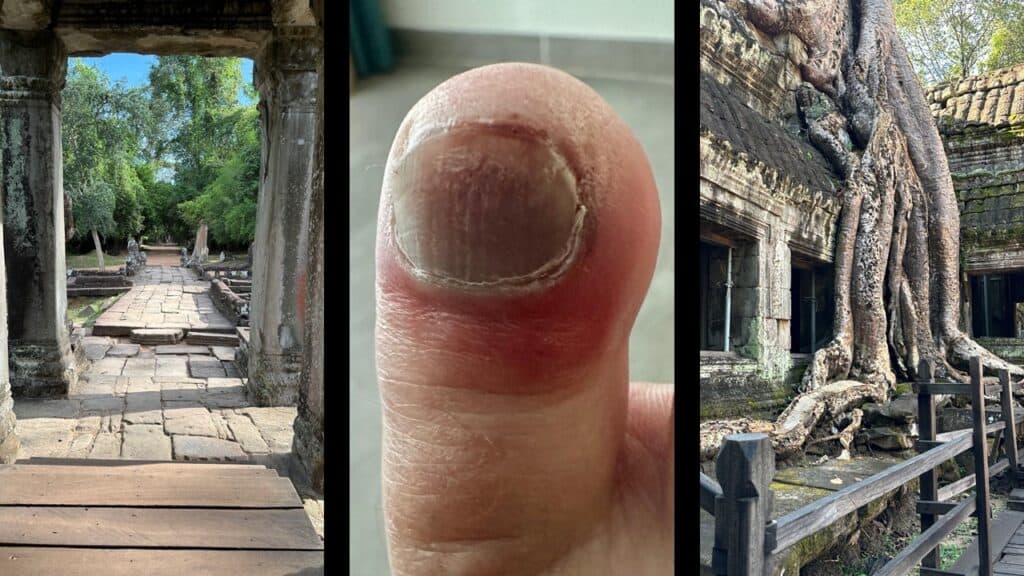
And I’ll be honest; it’s one of my own biggest personal fears. With my replaced knees and mobility issues on stairs, I’m always calculating my next step. I don’t bounce back like I used to; my blackened toe from a trip in Cambodia is proof, and the thought of taking a tumble somewhere remote or unfamiliar is enough to make me rethink half-day hikes or secret viewpoints that require a climb.
But it doesn’t mean I can’t travel. It just means I travel smarter.
My Stay-On-Your-Feet Travel Tips:
- I always pack supportive, grippy walking shoes (even if they’re not Insta-cute). This isn’t the trip to trial those strappy sandals.
- A folding walking stick or trekking pole can be a lifesaver on uneven paths or for that just-in-case moment. Even when I said it makes me look old, and I don’t like them, it has now been used on several occasions
- I choose accommodation with lifts (or at least request ground floor rooms), and I’m not shy about asking tour guides in advance about how many stairs are involved.
- I go slow, and I rest often. There’s no medal for racing to the top of a temple if I end up too sore to enjoy the view.
- And if a particular attraction looks too risky too many steps. I skip it without guilt. I remind myself: I’m here to enjoy, not to prove anything. And send my husband up to take the photos
The Takeaway
It’s not about how much you see, it’s about how you experience it.
Pace matters. Comfort matters. You matter.
Travelling in your 50s, 60s, or 70s isn’t about keeping up with the young backpackers in cargo shorts. It’s about tuning in to what you need and planning around that. And when you do, something wonderful happens, you actually enjoy it more. You see more. You feel more. And you’re not dragging your tired feet through one more temple or castle just to say you did it.
Final Thoughts: Travel Isn’t Just for the Young
It’s for the curious. The open-hearted. The ones who’ve waited long enough and finally said,
Why not now
At MyLifestyle.au, I celebrate that spirit of travel, slow, meaningful, and beautifully imperfect. Travel after 50 isn’t about chasing youth. It’s about reclaiming freedom, rewriting the script, and doing it your way.
So, if you’ve got some fears, that’s normal. Just don’t let them stop you from living your next chapter. You’ve earned it.
Let’s Keep Talking
If this article resonated with you, I’d love to hear your thoughts. What fears have you faced? What helped you overcome them? Leave a comment below or pop over to our Facebook page to join the conversation.
And if you’re ready to start planning that big trip, whether it’s close to home or halfway across the globe, I’ve created a Slow Travel Planner GBT just for you.
Because life’s too short to keep saying “maybe one day.”
Love MyLifestyle #Sheridan-Leigh


About the Author:

Below are some recent travels on an interactive map.
Alternatively, view the full interactive travel journey at MyLifestyle Travel Map
Click on a trip line to see images, posts, accommodation and travel information about the destinations.