
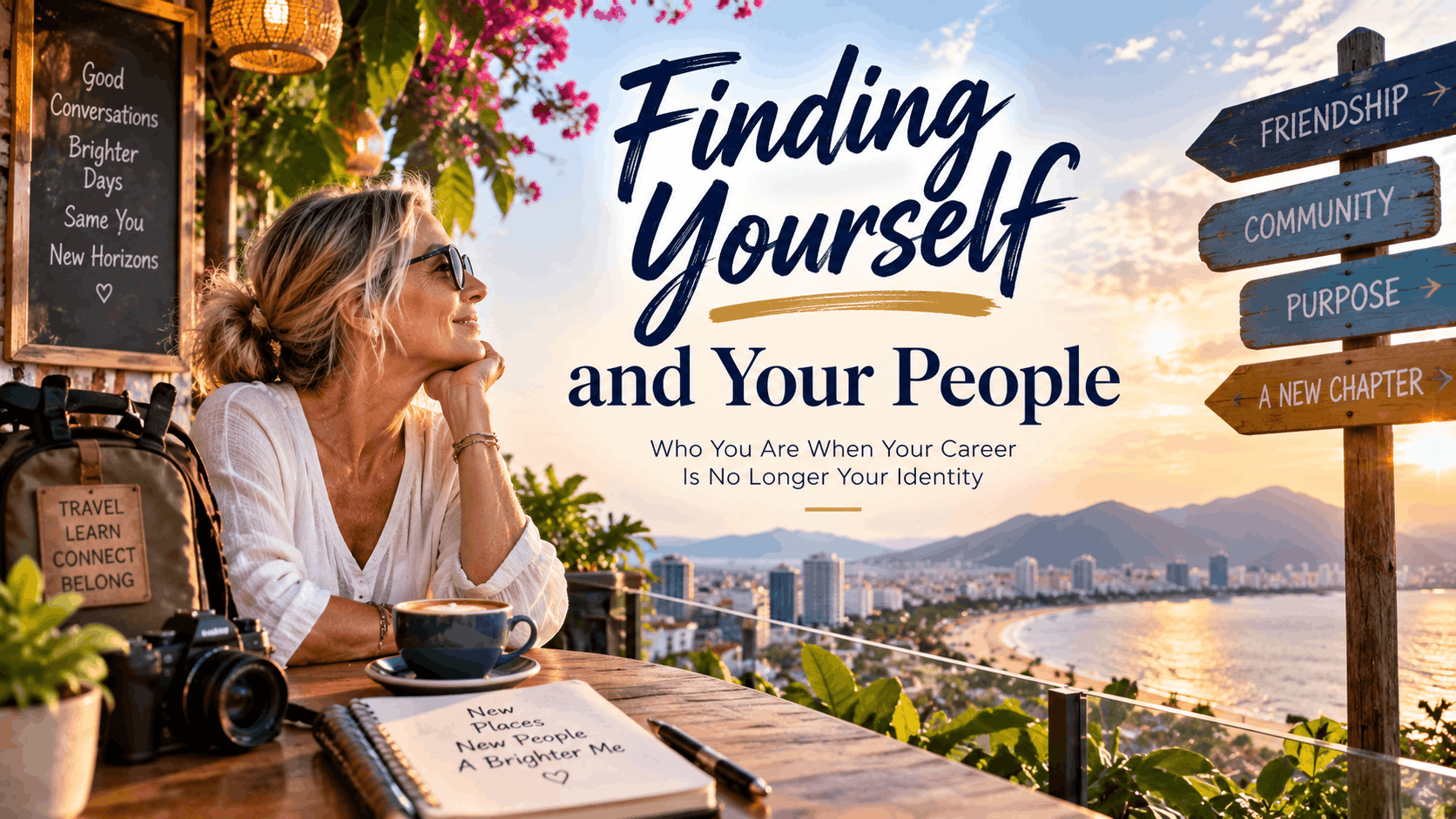
Finding Yourself and Your People
Who You Are When Your Career Is No Longer Your Identity
For most of my adult life, I was introduced by what I did. My work, responsibilities and involvement in the community gave me purpose, surrounded me with people and shaped the way I saw myself.
When those roles ended, I had to face a question many of us eventually encounter who are you when the position, title and familiar network are gone.
Moving overseas did not answer that question immediately. It did, however, give me the space to discover that friendship, belonging and purpose can be rebuilt around the person you are now, rather than the roles you once held.
When Life Changes the Person, You Thought You Would Be
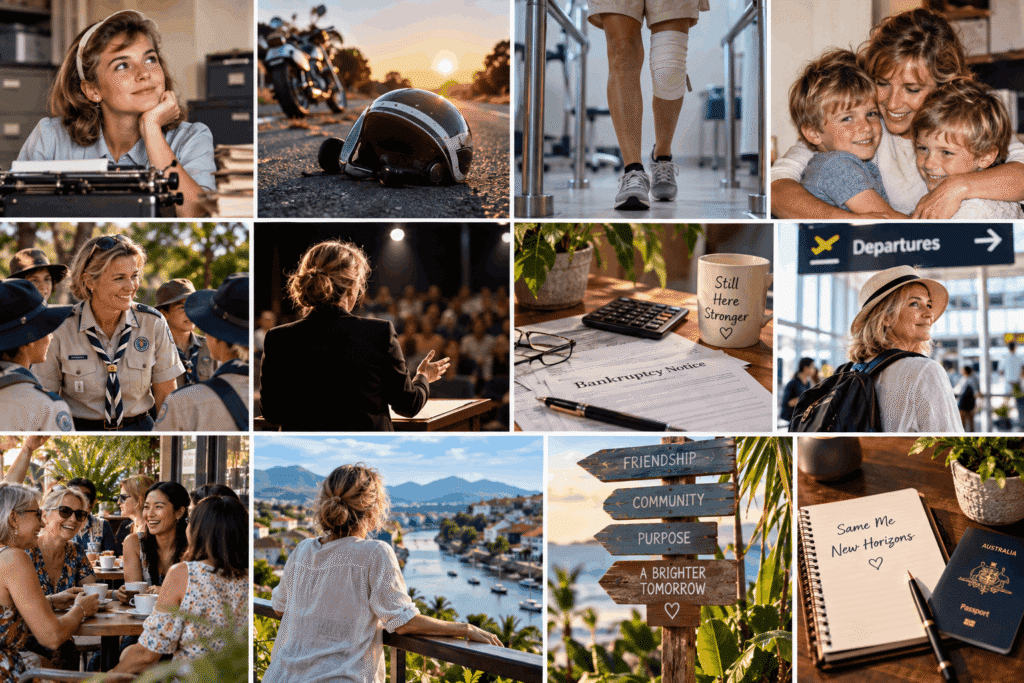
I have had several careers, although my working life did not begin in the direction I truly wanted. After leaving school, I completed a secretarial course and secured a junior position with a large insurance company. I hated it. Deep down, I had always known that I wanted to work with children, so I undertook further study and earned a position training as a mothercraft nurse.
For a while, it felt as though my life was falling into place. I had a boyfriend I adored, good friends and a starting date for the career I genuinely wanted.
Then, on one beautiful Saturday, everything changed. My boyfriend and I went for a ride on his new 500cc motorbike. It was a clear, dry day. Not far from his house, a red station wagon came through an intersection at around 80 miles an hour on the wrong side of the road.
I still remember the noise, the screaming and the lights and sirens of the ambulance. My boyfriend was badly injured, but my injuries were far more serious. At the hospital, my mother was told that my left leg would need to be amputated. She was a stubborn and forceful woman, and she refused to accept that decision without a fight. She fought, and she won.
I spent five months in hospital and another 19 months learning to walk unaided. The physical consequences remain with me, but I do not allow the accident to define my life. It did, however, change its direction. I never became a mothercraft nurse.
The boyfriend on the motorbike became my husband. David and I moved to Perth, raised two sons and built a life together. We studied, worked, bought a house and later bought and sold a restaurant before taking an even bigger risk on a tavern.
We lost the profitable tavern because of the greed of the landlords. We went bankrupt and lost almost everything we had worked to build. Bankruptcy is frightening, humiliating and deeply personal. It does not feel as though a business has simply failed. It feels as though you have failed.
But we still had our marriage, our family and our health. Once again, life had placed us on a path we had not chosen, and once again, we had to begin rebuilding.
When the Role Became Who I Was
My desire to work with children and education never disappeared. I returned to study and was offered a position in the childcare facility at Next Gen Kings Park. I remained there for 16 years, eventually becoming the manager responsible for all children’s activities.
I loved the children, families and people I met through the role. Being needed gave me purpose, and being part of that community became important to the way I saw myself. Some relationships formed there proved genuine and remain part of my life today.
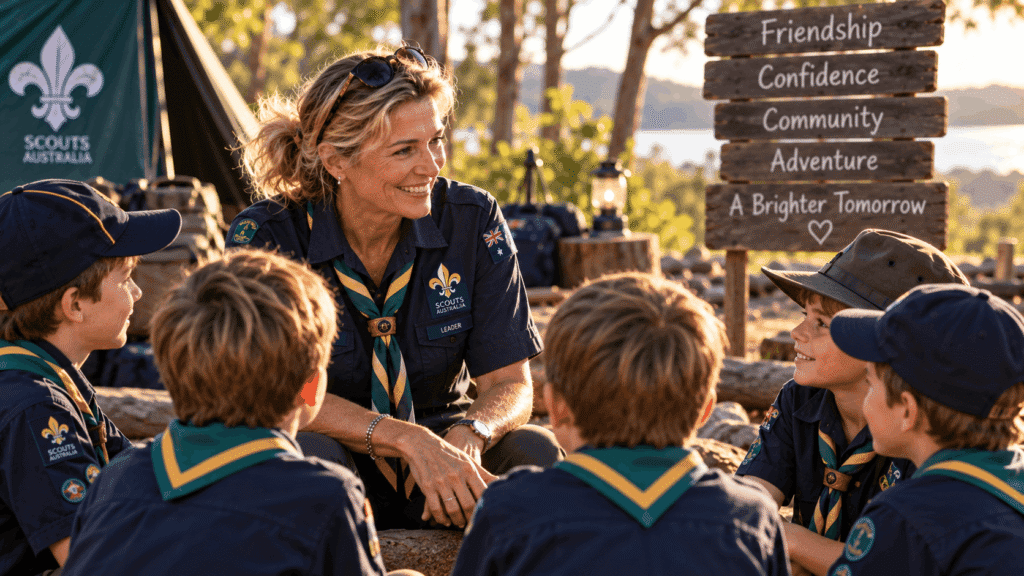
At the same time, another role had become even more deeply woven into my identity. My mother had enrolled me in Brownies when I was young. I progressed through Guides and Rangers and eventually achieved the Queen’s Guide Award. Guiding gave me friendship, confidence, responsibility and belonging. When I later wanted my two sons to experience something similar, our family joined Scouting. David and I became leaders while the boys moved through the youth sections.
For me, Scouting soon became much more than a family activity. I worked my way through the organisation and eventually became Deputy Chief Commissioner of Scouts WA. I served on national committees and contributed internationally to work supporting children with additional needs. I attended Jamborees in Australia and overseas, took part in workshops throughout the Asia-Pacific Region and helped develop procedures and policies.
I believed the work mattered, and I gave it everything I had. The volunteer hours sometimes equalled those in my paid employment and, if I am honest, my commitment occasionally came at the expense of my family.
Being a Scout was not simply part of my identity. It was my identity.
After 20 years, my role ended suddenly through the actions and decisions of someone in a senior position. There was no gentle transition or time to prepare. I felt discarded and replaced by a younger man whom I had helped to train and nurture.
I was devastated. I had not merely lost a position. I had lost the community, purpose and identity around which I had built much of my life. Then came an even more painful discovery. Of the hundreds of people I had met, many of those I believed were friends disappeared once I no longer held the title or influence. Today, only two remain my friends.
I wish I could say I am completely over it, but I am not. Even writing about it brings me to tears. When something has been the centre of your life for so long, you do not simply remove the uniform and become someone else overnight.
Yet the experience taught me something I will never forget. There is a profound difference between people who value your position and people who value you. I no longer measure friendship by the number of people who know my name or surround me when I am useful.
There may be fewer people in my life now, but the friendships are real. I will never again mistake being needed for being loved.
Starting Again Without the Old Labels
My story is personal, but the questions beneath it belong to many people. Who are you when a career finishes, children build lives of their own and the organisations that once needed you continue without you? Where do friendship and purpose come from when the old communities are no longer part of everyday life?
Moving overseas can make those questions more confronting. Visas, accommodation, healthcare and living costs can all be researched. Or I have done all the research for you and written a book called Living in Da Nang. It is harder to know whether you will be lonely, whether you will find people to share ordinary life with or whether you will always feel like an outsider.
In a new country, nobody knows the positions you held or the reputation you spent years building. At first, that can feel as though another piece of your identity has disappeared. It can also be freeing. People meet the person standing in front of them today. They do not know you because of a title or what you may be able to do for them. New friendships can form around who you have become.
How a Community Begins
A beautiful apartment, warm weather and an affordable lifestyle cannot protect anyone from loneliness. Building a social life overseas requires effort and, sometimes, the courage to walk into a room where you know nobody.
Friendships usually begin through ordinary encounters: a conversation over coffee, sitting beside someone at dinner, recognising the same face at another gathering or receiving a helpful reply in an online group. Familiarity grows each time people meet.
Local Facebook and WhatsApp groups, coffee mornings, social dinners, classes and volunteer activities can provide a starting point. Joining online is useful, but eventually you have to step beyond the screen. You have to introduce yourself, return to the gathering and occasionally be the person who asks, ‘Would you like to meet for coffee?’
The first event may not feel right. Other people can appear confident and established while you feel as though you are standing at the edge of their circle. It helps to remember that almost everyone in the room was once the newcomer.
Go more than once before deciding you do not belong. You will not connect with everyone, nor should you expect to, but being recognised when you return can be the first small sign that you are becoming part of something.
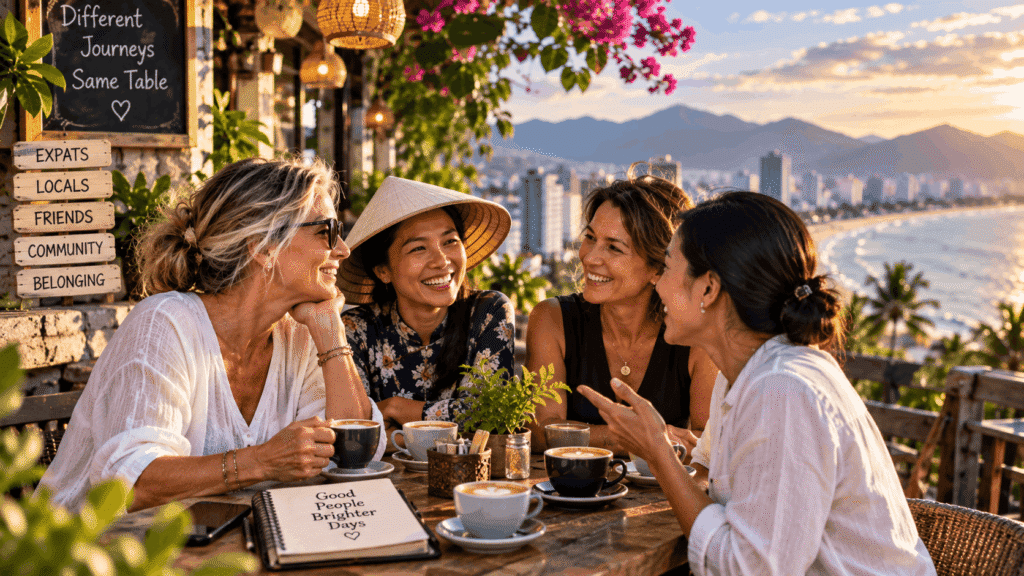
Community also grows when you stop waiting to be welcomed and begin welcoming others. Notice the new person. Remember their name. Make room beside you. Invite one person for coffee rather than waiting for a large social invitation. Often, the person beside you is hoping just as strongly as you are that someone will begin a conversation.
Friendship Purpose and Belonging
Expat groups can be invaluable. Their members understand the practical and emotional challenges of living away from home, and they can turn an unfamiliar city into a place where you begin to feel known.
But living overseas should not mean remaining entirely inside an expat circle. Relationships with local people create a deeper connection to the country itself. Language differences can make those friendships slower to develop, but patience, humour and genuine interest bridge many gaps.
For me, volunteering as an English teacher has become an important part of that connection. Working with a wonderful Vietnamese professor and encouraging students to speak English allows me to contribute in a way that still feels true to who I am. The students may be learning from me, but the exchange is never one-sided. They teach me about Vietnam, their lives and different ways of seeing the world.
Through teaching, I found something I feared I had lost: the knowledge that I can still make a difference. Yet this purpose does not need to consume me. I can contribute without recreating the pressure of my earlier life. I can help without believing that usefulness is the reason people value me.
Friendships overseas also carry a particular uncertainty. People leave as visas, health, work, finances and family responsibilities change. Some friendships continue across countries while others fade. That does not make them false. Some people remain for decades; others arrive at exactly the moment we need one another and then move along a different path.
The goal is not to collect as many friends as possible. It is to find people around whom you can be yourself, people who share the laughter and difficult days and who value your company rather than your position.
What Helped Me Build a Community
The most useful lessons have been simple:
- Join local groups, but make the effort to meet people in person.
- Return more than once before deciding a gathering is not for you.
- Invite one person for coffee instead of waiting to be invited.
- Volunteer or share a skill without allowing it to take over your life.
- Build relationships with local people as well as other expats.
- Welcome newcomers and remember how your own first gathering felt.
Most importantly, allow friendships time to develop. Acquaintances and true friends are not the same thing, and there is no need to force every connection to become something deeper.
Who I Am Now
For much of my life, identity came from the roles I held. I was a wife, mother, employee, business owner, manager, trainer and Scout leader. Each role mattered, but some became so closely tied to my identity that when they ended, I no longer knew who I was without them.
Moving overseas did not give me another title to replace the old ones. It gave me the space to realise that I did not need one.
I am still a wife, mother, teacher and friend. I still care deeply about people, education and making a difference. Those parts of me were never created by a uniform, job description or committee position. They belonged to me all along.
Today, I value a quieter and more uncomplicated life. I enjoy meeting friends for coffee or dinner, teaching students, learning about Vietnam and sharing everyday life with David. My world may appear smaller than it once was, but it feels more honest and uncomplicated.
I no longer need hundreds of people to know my name or a senior position to prove my value. The people closest to me know me without the titles. They are part of my life because we have chosen one another.
Finding yourself does not mean becoming an entirely different person. It means recognising what remains when the roles, expectations and labels fall away.
Starting again overseas can be uncomfortable and uncertain. It can also provide the chance to build a community around the person you are now rather than the person everyone remembers you being.
Sometimes, in finding your people, you find yourself as well.
About the Author:
Sheridan-Leigh is the passionate voice behind the MyLifestyle Blog, where life is celebrated with vibrant stories and insightful travel tips. With a deep love for slow travel, she believes in truly experiencing each destination, creating connections beyond the surface. Her blog is a blend of personal stories, expert advice, and a philosophy that life is for living to the fullest and is rich with opportunities for growth and adventure. Join Sheridan-Leigh as she shares her journey, inspiring others to embrace life, travel deeply, and live fully.
If you have enjoyed this post, checkout my other journal stories.
Below are some recent travels on an interactive map.
Alternatively, view the full interactive travel journey at MyLifestyle Travel Map
Click on a trip line to see images, posts, accommodation and travel information about the destinations.