


The Strange Things That Become Normal When You Live Overseas
The Funny Side of Adjusting to Everyday Life Abroad
When you first begin living overseas, almost everything requires concentration. Crossing the road becomes a strategic operation. Buying milk requires careful study. Ordering lunch involves pointing, translating and hoping the photograph bears some relationship to what eventually arrives.
You feel ridiculously proud when a delivery driver finds your building. You tell people at home that you ordered coffee entirely in another language, although you may leave out the part where you received three coffees instead of one.
Then, without noticing exactly when it happened, the unfamiliar routines become ordinary. You know which shop sells the yoghurt you like, where to wait for a car and which noises outside require attention. The country has not become less different. You have simply become better at living there.
Normal Is Different Everywhere
Most of us grow up believing that our way of doing things is the sensible way. We drive on the correct side of the road, queue properly, eat appropriate breakfast food and understand exactly how a checkout should operate.
Unfortunately, billions of people elsewhere are equally convinced that their way is normal and that some of our habits are slightly ridiculous.
Life abroad soon teaches you that normal depends entirely on where you are standing. Singapore can make you feel guilty for standing on the wrong side of an escalator. In Thailand, a convenience store can solve most of life’s immediate problems. In Indonesia, eight kilometres can be either a short drive or your main activity for the afternoon. In Canada, leaving the house in winter may require more equipment than a minor expedition.
Eventually, you stop asking why everything is not done the Australian way. Sometimes another system is better. Sometimes it is worse. Sometimes nobody can explain it, but everyone else appears to be coping, so you join in and hope for the best.
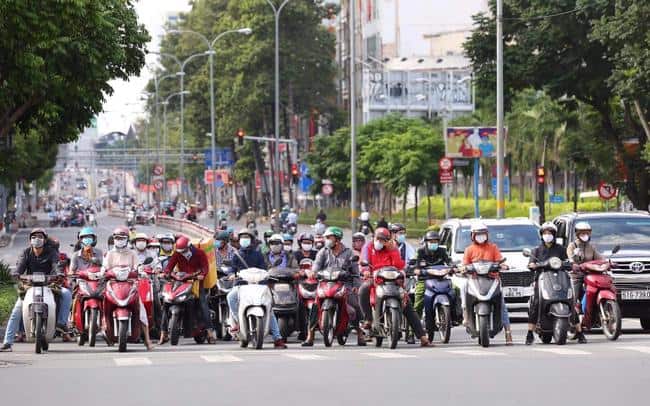
Traffic That Should Not Work but Somehow Does
Vietnamese traffic appears to have no gaps, no obvious order and absolutely no reason to work. Yet somehow, it flows.
Thousands of motorbikes merge, turn and move around one another like a giant school of fish. From the footpath it looks like chaos. From inside it, everyone seems to understand movements that have never been communicated through indicators, road markings or anything else I recognise.
Accidents do happen. When someone comes off a scooter, other riders will often stop, move the person and bike safely to the side, check that everything is under control and continue on their way. Within minutes, the traffic closes over the space as though nothing happened.
The real danger can be the visitor who hires a scooter and assumes that knowing how to ride means knowing how to ride there. It does not.
A tourist sees an empty space and thinks, That gap is for me. Local riders know that the same gap has already been claimed by six motorbikes, a delivery rider carrying a refrigerator and a woman transporting enough flowers to decorate a wedding.
I have lived in Indonesia, Thailand, Canada, Australia, Singapore and Vietnam, and I am perfectly comfortable admitting that I will not drive in most of them. Every country has its own road language, and I am not prepared to pretend I am fluent simply because someone is willing to rent me a vehicle.
Even when I return to Australia, I drive cautiously for the first few days while my brain remembers the rules and which direction the traffic is supposed to come from. Other drivers may think I am being ridiculously careful. That is fine. I would rather be the nervous woman waiting too long at a roundabout than the confident tourist discovering that the gap was never hers.
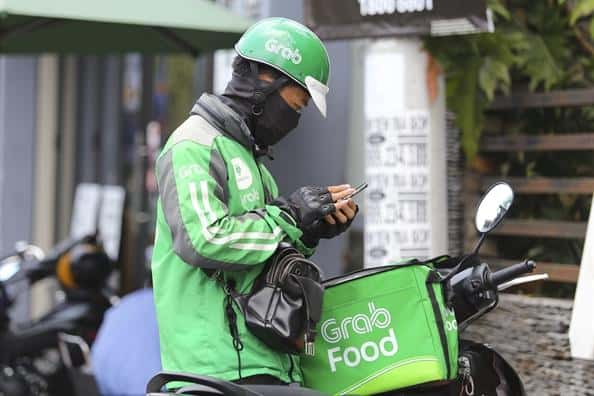
When Technology Knows Everything Except Where You Live
Living overseas creates a very close relationship with your phone. It becomes your translator, navigator, currency converter, transport organiser and emergency source of information. Everything works beautifully until a driver telephones you.
I learnt this while preparing to attend an education event one evening. I needed a quick meal, so I ordered chicken fried rice through Grab from a cafe within walking distance of our apartment.
What could possibly go wrong? I sat in the lobby watching the reassuring updates: In the kitchen. Preparing your order. Out for delivery. Perfect. The cafe was around the corner. My dinner should have arrived before I had time to become hungry.
I waited. And waited. Eventually, the driver messaged: I cannot find you. I replied that I was in the lobby and sent my address. He asked where I was. I sent it again. There was a long silence before he informed me that this was not the address he had been given. This was surprising because I knew where I lived. I was sitting inside it.
Then he rang. He spoke no English, and at that time I spoke very little Vietnamese. What followed was less a conversation and more two people taking turns saying addresses neither of us understood. My quick meal from the cafe around the corner had apparently set off on a sightseeing tour of Da Nang.
I finally offered to pay again if he delivered it to my actual address. I thought he agreed. A short time later, the app sent me a photograph proving that my chicken fried rice had been left outside a completely unfamiliar building.
I never saw it again. Somewhere in Da Nang, a stranger opened a door and discovered that the universe had provided dinner. I went to my event hungry. My chicken fried rice had a much better evening.
The Small Things You Stop Questioning
The biggest adjustments in everyday life overseas are not always dramatic. They are usually the small things that once seemed strange and eventually become part of the household routine.
Drinking water is a good example. In Australia, it generally comes from a tap. Elsewhere, it may involve large bottles, pumps, deliveries and an empty-container exchange system that nobody formally explains.
Everything runs efficiently until you forget to order. Then the final few centimetres become a precious natural resource. Coffee is reconsidered. Cooking is delayed. You begin discussing the water bottle in the worried tone normally reserved for a critically ill relative.
Street furniture also requires adjustment. Across Southeast Asia, some of the best food is served at tables apparently designed for a children’s birthday party. At six feet tall, David can look as though he is trying to fold himself into hand luggage. I am much shorter, so getting down is easy. Getting back up with any dignity is where the entertainment begins.
Weather stops being polite conversation and becomes a daily operating system. Heat decides when you leave home. Rain decides which streets still qualify as streets. Humidity decides whether something forgotten in a cupboard remains clothing or becomes a science project.
And convenience changes your standards very quickly. Cars arrive within minutes, food appears at the door and laundry returns washed, dried and folded. Then you visit Australia, see the delivery fee for one meal and discover that you have suddenly remembered how to cook.
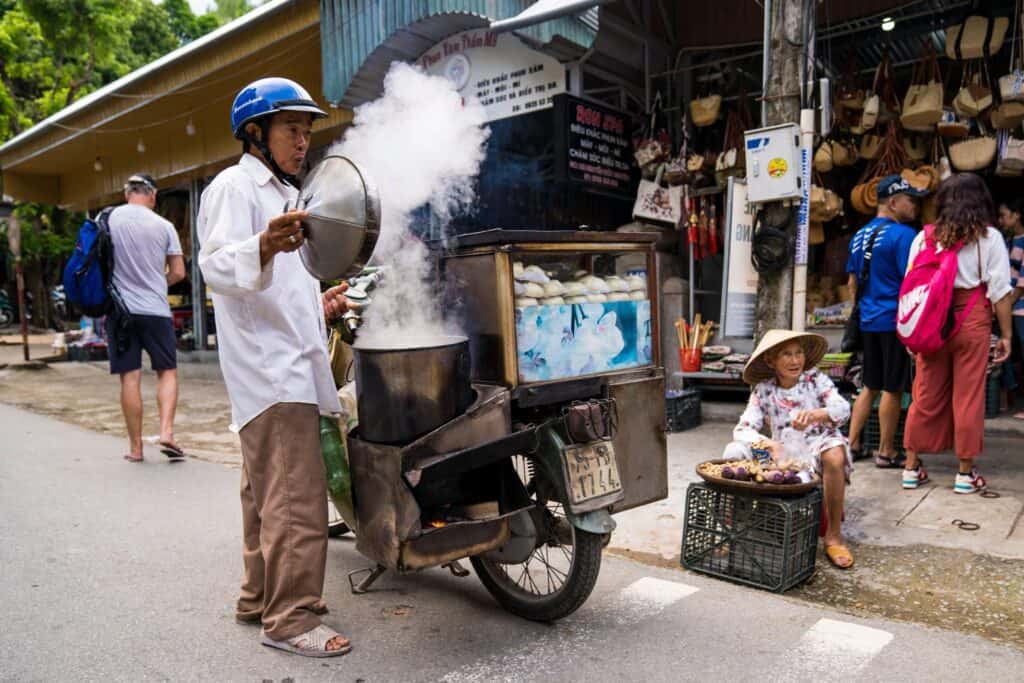
The Soundtrack You Never Asked For
Every country has its own soundtrack. In Da Nang, it includes motorbike horns, construction, barking dogs, karaoke performed with confidence far greater than ability and street vendors travelling through the neighbourhood with loudspeakers.
The most recognisable is the bánh bao vendor. Bánh bao are steamed buns with savoury fillings, sold from a scooter that announces their availability to everyone within several kilometres.
“Bánh bao! Bánh bao đây!” Again. And again. And again.
The recording does not merely enter your apartment. It enters your brain, makes itself comfortable and refuses to pay rent.
At first, I wondered why steamed buns needed to be advertised at that volume, particularly when the vendor appeared to pass our building for the seventeenth time that night.
Then I travelled away from Vietnam and missed it. Streets elsewhere seemed strangely quiet. Nobody rode past loudly confirming that steamed buns continued to exist. How were people expected to manage?
While staying in Australia, I have even been known to wake David by suddenly calling, “Bánh bao! Bánh bao đây!” I find this very funny. David, who had been peacefully asleep, does not always share my appreciation of Vietnamese street culture.
When Home Becomes the Strange Place
The clearest sign that you have adjusted to living overseas often appears when you return home.
Australian roads suddenly seem unusually organised. Shops close earlier than expected. A short taxi ride requires a small financial discussion, and ordering dinner can cost enough to make the refrigerator look surprisingly attractive.
For the first few days, I drive carefully, search for services that are no longer available at the touch of an app and wonder why every simple outing requires keys, a car and a parking strategy.
That is when you realise the foreign country did not become normal because it changed. You did. The traffic, mysterious phone calls, tiny stools and enormous water bottles have become ordinary life.
Not perfectly understood. Not always logical. But ordinary all the same.
And if I ever become too comfortable, there is always a missing meal, an unfamiliar checkout or a loudspeaker selling steamed buns to remind me that I still have plenty to learn.
Love MyLifestyle #Sheridan-Leigh
Read my personal journal stories here.
About the Author:
Sheridan-Leigh is the passionate voice behind the MyLifestyle Blog, where life is celebrated with vibrant stories and insightful travel tips. With a deep love for slow travel, she believes in truly experiencing each destination, creating connections beyond the surface. Her blog is a blend of personal stories, expert advice, and a philosophy that life is for living to the fullest and is rich with opportunities for growth and adventure. Join Sheridan-Leigh as she shares her journey, inspiring others to embrace life, travel deeply, and live fully.
If you enjoyed this read some other journal stories.