

What To Do If Your Flight Is Cancelled
Real Travel Tips That Actually Help
Real-world advice from experienced travellers on surviving delays, missed connections, airport chaos, and travel disasters without losing your mind.
There’s a certain moment every traveller dreads.
You’re standing in the airport feeling excited, tired, hopeful, maybe already dreaming about the first cocktail, beach walk, bowl of noodles, or hotel breakfast waiting on the other side of the flight.
Then you glance up at the departure screen expecting to see those comforting words:
On Time
Instead, you see the one word nobody wants to read.
Flight Cancelled.
And in an instant, the entire mood changes.
When Your Flight Gets Cancelled First Things To Do
The calm excitement of travel is suddenly replaced with confusion, airport announcements, stressed passengers, app notifications constantly pinging your phone, and that horrible feeling of not quite knowing what you’re supposed to do next.
What happens now?
Who do you talk to?
Can you get a refund?
Will travel insurance help?
Are you suddenly paying for accommodation yourself?
How long could this take?
Over the years, we’ve learned that travel disruptions are simply part of modern travel. It doesn’t matter whether you’re flying budget airlines around Southeast Asia or taking a long-haul international trip, delays and cancellations happen.
But here’s the important part: A cancelled flight does not have to ruin your entire holiday. Usually, the travellers who cope best aren’t the lucky ones. They’re the prepared ones.
And honestly, I learned that lesson the hard way.
I still remember a family holiday to Bali many years ago when this happened to us.
At the time, life was incredibly busy. I was working full-time, juggling family life, school schedules, and trying to organise a holiday that somehow kept everyone happy at once which any parent knows is almost a full-time job on its own.
Our two children were still at school, and like many Australian families, we had to carefully navigate the delicate conversation around taking them out during term time. Every leave request mattered. Every day off work mattered. This wasn’t just a casual weekend away. This was the holiday we desperately needed.
We chose Bali because from Perth it felt achievable. Just a short flight away. About three hours from home and suddenly you’re in a completely different world.
Weeks were spent researching hotels. Booking.com Not just any hotels the kind that would keep the kids entertained while also giving my husband and I a tiny chance to breathe, relax, and recover from the exhaustion that modern life quietly builds up around you.
Finally, departure day arrived.
My parents drove us to Perth Airport and dropped us at the Kiss and Fly area. The kids were beyond excited. My husband looked completely burnt out and more than ready for two weeks away. And honestly, so was I.
There’s something magical about the beginning of a family holiday. Suitcases rolling across the terminal floor. Kids talking too loudly about swimming pools. Parents already mentally switching into holiday mode before the plane has even boarded.
Then suddenly the atmosphere changed. There was commotion near the departure gates. You could hear frustrated conversations beginning to rise above the normal airport noise. Staff were moving quickly. Phones were coming out everywhere.
And then I looked up at the departure board.
Jetstar JQ117 — Denpasar, Bali — Cancelled.
I just stared at the screen in disbelief.
The kids immediately started asking:
- “What do you mean cancelled?”
“When are we leaving?”
“Are we still going?”
Meanwhile, all around us, people were reacting in completely different ways. Some angry. Some confused. Some crying. Some already standing in enormous customer service queues.
I remember feeling completely stunned. Not angry. Just overwhelmed. Because in that moment, weeks of planning suddenly felt uncertain.
But here’s the interesting part looking back now: Nobody was really at fault. Not the airline. Not the airport. Not even Bali itself.
Mother Nature had simply decided otherwise.
Overnight, Mount Agung had erupted, sending volcanic ash clouds into the atmosphere. And volcanic ash is extremely dangerous for aircraft engines. Flights in and out of Bali were grounded until further notice.
That was the moment I truly understood something important about travel. Sometimes things go wrong that nobody can control.
And when they do, staying calm, informed, and adaptable becomes one of the most valuable travel skills you can have.
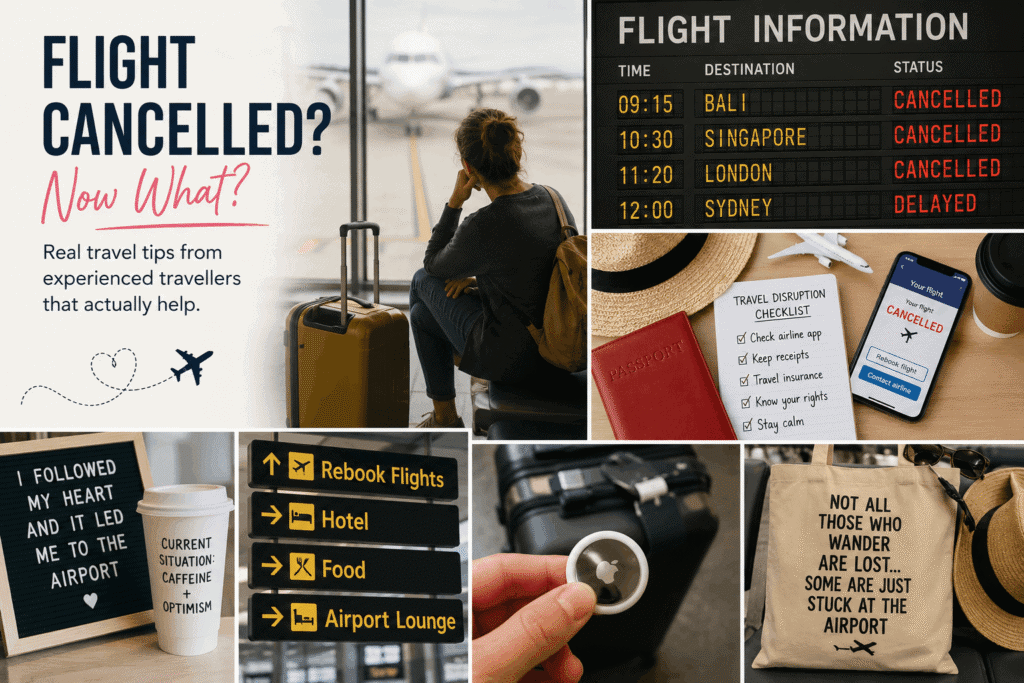
First: Don’t Panic — Move Quickly
The first few minutes after a cancellation matter more than most people realise. Many travellers freeze. Others immediately join the longest customer service queue in the airport. Meanwhile, experienced travellers are already:
- checking the airline app
- searching alternative flights
- contacting support online
- reviewing nearby accommodation Booking.com
- taking screenshots of notifications
The earlier you act, the better your options usually are.
Airlines often start rebooking passengers automatically, but the best replacement seats can disappear quickly especially during busy travel periods.
One thing I’ve learned over the years is that staying calm gives you a huge advantage. Airport staff are often dealing with frustrated passengers all day long. Being polite, patient, and organised genuinely helps.
Understand Why Your Flight Was Cancelled
Not all cancellations are treated equally. As in our Bali case it was no one’s fault.
The reason behind the disruption can affect:
- refunds
- compensation
- accommodation support
- meal vouchers
- travel insurance claims
Generally speaking, cancellations fall into two categories:
Airline-Controlled Problems
These may include:
- staffing shortages
- operational issues
- aircraft maintenance problems
- scheduling issues
In these situations, airlines are often more likely to provide compensation or assistance.
Extraordinary Circumstances
These are situations outside the airline’s control, such as:
- severe weather
- typhoons
- airport closures
- natural disasters
- political instability
- air traffic control problems
In these cases, compensation may be more limited. This is why it’s important to ask the airline directly: “What is the official reason for the cancellation?”
That small detail can matter later if you need to make a claim.
Check The Airline App Before Standing In Line
This is one of the biggest travel tips I can give people.
Before standing in a customer service line for two hours, check:
- the airline app AirAsia.com
- email notifications
- SMS updates
- live chat support
Many airlines now allow passengers to:
- accept alternative flights
- request refunds
- select new seats
- change bookings
- claim accommodation assistance
without ever speaking to a staff member face-to-face. Sometimes the digital solution is dramatically faster than the physical queue.
Keep Every Receipt, Screenshot, And Email
This part matters more than most travellers expect.
If you end up paying for:
- accommodation
- meals
- transport
- taxis
- replacement flights
you may later need proof for:
- insurance claims
- airline reimbursement
- compensation requests
Create a small travel disruption folder on your phone and save:
- screenshots
- booking confirmations
- cancellation notices
- receipts
- emails
- chat transcripts
It takes seconds to do but can save enormous frustration later.
Know Your Rights as an Australian Traveller
Many Australians assume airlines automatically provide compensation for delays and cancellations. Unfortunately, it’s not always that simple. Australian consumer protections can help in some situations, but airline policies vary significantly depending on:
- the airline
- your ticket type
- the country involved
- the reason for cancellation
Some airlines may offer:
- rebooking
- flight credits
- accommodation
- meal vouchers
- partial refunds
- full refunds
Others may offer very little unless pushed. This is why reading the airline’s cancellation policy before travelling is actually a smart idea even though most people never do it.
Why Travel Insurance Matters More Than People Think
Good travel insurance I recommend SafetyWing.com can completely change how stressful a cancellation becomes.
Depending on your policy, insurance may help cover:
- emergency accommodation
- meals
- transport
- replacement flights
- missed connections
- additional travel expenses
But there’s an important catch: Not every policy covers every situation.
Some policies exclude:
- weather events
- strikes
- known disruptions
- airline insolvency
- pre-existing conditions
This is why reading the fine print matters far more than travellers think. One of the biggest mistakes people make is buying insurance purely based on price without understanding what’s actually included.
Sometimes The Cheapest Flight Becomes the Most Expensive
Budget airlines can be fantastic value especially throughout Asia. But when disruptions happen, the level of support can vary enormously. Some airlines proactively assist passengers.
Others provide very little guidance at all. That doesn’t mean you should avoid low-cost airlines. It simply means you should travel with realistic expectations.
Experienced travellers often balance budget savings with:
- flexible schedules
- backup funds
- insurance
- extra overnight buffer days
Especially before important events or international connections.
Our 42-Hour Travel Disaster to A Cruise Ship
My husband and I are avid cruisers. Honestly, if someone announced tomorrow that a cruise ship was leaving from the moon, we’d probably start checking cabin prices.
So, when Royal Caribbean announced the launch of one of their brand-new ships, I was obsessed immediately. The photos. The videos. The endless social media posts showing sparkling pools, giant theatres, and enough food to feed a small country.
There was only one tiny problem. The ship was sailing out of Fort Lauderdale in the United States… and we were sitting comfortably in Perth, Western Australia.
A mere casual 18-plus hours away. No problem, we thought confidently in the way travellers always do moments before things go terribly wrong.
We booked Qantas on the mighty A380 out of Melbourne. The plan was beautifully organised. We flew across Australia the night before and stayed at the airport hotel like seasoned international travellers who absolutely had their lives together.
The next morning, we rolled our suitcases into Melbourne International Airport feeling relaxed, professional, and extremely pleased with ourselves. This was it. The big adventure. Two flights and then straight onto our dream cruise ship.
Easy.
The plan was:
- 12 hours to Los Angeles
- a comfortable connection
- then on to Fort Lauderdale
- board the ship
- immediately start consuming cocktails with tiny umbrellas
Simple.
Sitting in the departure lounge, we could see our beautiful Qantas A380 parked outside on the tarmac looking enormous and majestic like the Queen of the Skies.
Boarding time arrived. Then passed. No announcements. No panic. No updates. No suspicious airport music. Nothing.
Meanwhile, a few technicians casually wandered underneath the wing and started looking at something very carefully. At first, nobody thought much of it. Then somebody pulled out duct tape.
Now listen I was a Scout for years I love duct tape as much as the next Australian. It can fix garden hoses, camping chairs, children’s school projects, and occasionally relationships. But seeing it used underneath a plane wing before an 18-hour international flight was not exactly filling me with confidence.
People around the gate started quietly side-eyeing each other. Nobody wanted to say it out loud. But we were all thinking it. Surely that’s not official plane maintenance tape. Eventually, after what felt like several emotional lifetimes, boarding was finally announced.
By this stage we were already running about 1 hour and 45 minutes late. I asked the lovely girl at the counter Do you think we’ll miss our connecting flight? Without even blinking she smiled professionally and said Oh no, they’ll easily make up that time in the air. They did not make up the time. Not even close.
We landed in Los Angeles and immediately entered what can only be described as an Olympic event involving immigration queues, security checks, speed walking, escalators, suitcase dragging, and two middle-aged Australians sweating through terminal corridors like contestants on a reality survival show. Airport staff rushed us toward the gate. And there it was. Our next aircraft. Still sitting there. Right outside the window. Close enough to touch emotionally.
I honestly thought: They’re waiting for us! Humanity still exists! They were not waiting for us. Apparently, in the United States, you cannot board less than one hour before departure. Not 59 minutes. Not 58 like us. Not even if you have just flown across the Pacific Ocean fuelled entirely by airport coffee and determination.
No amount of pleading, explaining, smiling, or desperate Australian charm was getting us onto that aircraft. And at this point, let me remind you: Our cruise ship was in Fort Lauderdale. And we were in Los Angeles. Which is roughly the equivalent of saying: Your holiday is in Perth, but you’re currently stranded somewhere near Bali.
Thankfully, the ground staff were absolutely amazing. Within what felt like minutes, they had rebooked us onto two completely different flights involving airports I no longer remember because by then my soul had left my body. At that point I didn’t care about luxury, comfort, or dignity anymore.
My husband was seated about ten rows behind me on one flight. The man beside me spent the entire trip pretending not to notice my wild exhausted appearance and emotionally broken airport energy. I respected him for that.
What was supposed to be a relatively straightforward journey somehow turned into: four airports extra flights endless queues airport food that cost more than a small mortgage payment and approximately 42 hours of travelling
By the time we finally boarded the cruise ship, I honestly felt like I deserved my own welcome parade and possibly a small commemorative statue in the atrium.
But you know what the moment we stepped onboard, looked out at the ocean, and finally exhaled properly for the first time in nearly two days It was all worth it. Well eventually.
What To Do If You’re Stranded Overnight
An overnight cancellation can feel overwhelming, particularly in unfamiliar countries.
If this happens:
- Secure accommodation quickly Booking.com
- Stay close to the airport if rebooking early
- Confirm transport options
- Keep receipts
- Charge your devices immediately
- Notify family or accommodation providers
Airport hotels can book out surprisingly fast during mass cancellations. Even if the airline says accommodation may be covered, you may still need to pay upfront and claim later.
Why Connecting Flights Can Become a Nightmare
This is where many travellers get caught out. If all flights are booked on a single itinerary, airlines are usually more responsible for helping you reach your destination.
But if you booked separate tickets independently, things become much riskier. For example: Airline A delays your first flight You miss Airline B Airline B may say the missed flight is entirely your responsibility
This is why many experienced travellers avoid tight self-managed connections especially internationally.
The Emotional Side of Travel Disruptions
Nobody talks about this enough. Travel disruptions are exhausting. You’re often: tired carrying luggage navigating unfamiliar systems dealing with language barriers worrying about money trying to salvage plans. And sometimes disappointment hits harder than the financial cost.
One thing I’ve learned through travel is this: The calmer you stay, the better decisions you make. Not every travel problem can be prevented. But most can be managed far better with patience, flexibility, and preparation. Sometimes the best travel stories eventually come from the trips that didn’t go perfectly.
Practical Things Experienced Travellers Always Do
Over time, many frequent travellers develop little habits that make disruptions easier to handle.
Things like carrying a power bank, keeping emergency cash, using luggage trackers, travelling with flexible expectations, saving airline apps before departure, screenshotting important bookings, allowing buffer days between major connections. These small habits often make a bigger difference than people realise.
There are moments while travelling where you genuinely question whether the universe is testing you personally. This was one of them.
Why We Now Travel with AirTags Everywhere
We’ve used AirTags for years now and honestly, sometimes they’re less about security and more about playing an international version of Where’s Wally with your luggage. Particularly in Asia, where the carousel number on the screen often feels more like a suggestion than factual information.
My husband is an international speaker and regularly presents on cruise ships and at events around the world. On this particular trip, he’d been booked to speak for a cruise line he hadn’t worked with before, departing from Singapore. Since we have friends there, we decided to arrive a couple of days early and enjoy ourselves before boarding.
Everything was going beautifully. Which, in hindsight, should have worried me. We checked in our luggage including the very important suitcase containing all his speaking clothes. Suits, shirts, dress shoes, stage outfits basically the entire professional and respectable version of my husband.
We boarded the plane, settled in, and just before take-off I made the mistake every anxious traveller eventually makes. I checked the AirTags. Three bags showed happily sitting on the aircraft. The fourth one his one the important one was still apparently enjoying itself back at the terminal.
Now at this point the aircraft is already taxiing. We are moving. There is absolutely no chance they are turning this plane around because a middle-aged Australian man is aggressively staring at a tiny glowing suitcase icon on her phone.
Still, we pressed the call button. The flight attendant came over and we explained the situation, hoping they could at least flag the bag for the next flight. She basically gave us the airline version of: Well that’s unfortunate. And left. Very reassuring.
My husband spent the next five hours in full panic mode imagining himself giving professional presentations in Singapore dressed like a confused backpacker. Meanwhile, I moved into what I call Practical Survival Wife Mode. In my head I’d already solved the problem.
Money fixes this.
I know an excellent tailor in Chinatown. We can get a new suit made. Shirt Easy. Vest? Done. Shoes? Fine. Underwear, socks, deodorant, emergency panic-recovery supplies? Singapore has shops. We can get this done.
Our friend, instead of enjoying a relaxed lunch with us, would now be dragged around Singapore on a high-speed emergency shopping mission fuelled by stress and coffee. By the time we landed at 6am, I was mentally prepared for battle.
We stood at the luggage carousel waiting for my suitcase. Round and round the bags came while my husband looked increasingly pale. Then I spotted one in the distance. It looked familiar. Very familiar.
As it moved slowly towards us, I watched hope return to his face like a man seeing land after months lost at sea. “It IS mine!”
He practically launched himself at the conveyor belt, dragged the suitcase off, dropped to his knees and hugged it. Actually, hugged it. In the middle of Singapore Airport. Not even slightly concerned by the growing number of passengers staring at the emotional reunion between a man and his luggage. Honestly, after five hours of stress, I considered hugging the bag too.
Final Thoughts
Flight cancellations are frustrating. There’s no glamorous way to explain sitting on airport carpet at midnight eating overpriced chips while aggressively refreshing an airline app. But over the years, I’ve learned something important about travel.
The people who enjoy travelling the most usually aren’t the ones with perfect itineraries, flawless flights, or luxury upgrades. They’re the ones who adapt quickly when things go wrong.
Because eventually, almost every traveller ends up with:
- a missed connection
- lost luggage
- an airport meltdown
- a night in a hotel they never planned to stay in
- or a story that becomes funny about three days later
Travel has a wonderful way of reminding us that we’re not completely in control. Flights get cancelled. Volcanoes erupt. Weather changes. Bags disappear. Aircraft somehow get repaired with what appears to be Bunnings supplies.
And yet somehow, the trip usually works out anyway. Maybe not perfectly. Maybe not smoothly.
But often memorably.
And honestly, years later, those are usually the stories we end up telling the most.
About the Author:
Sheridan-Leigh is the passionate voice behind the MyLifestyle Blog, where life is celebrated with vibrant stories and insightful travel tips. With a deep love for slow travel, she believes in truly experiencing each destination, creating connections beyond the surface. Her blog is a blend of personal stories, expert advice, and a philosophy that life is for living to the fullest and is rich with opportunities for growth and adventure. Join Sheridan-Leigh as she shares her journey, inspiring others to embrace life, travel deeply, and live fully.
Below are some recent travels on an interactive map.
Alternatively, view the full interactive travel journey at MyLifestyle Travel Map
Click on a trip line to see images, posts, accommodation and travel information about the destinations.