

Travel Etiquette: A Passport Doesn’t Make You Open-Minded
Five true travel stories about cultural differences, questionable manners and why a little respect goes a long way.
I’ve met some absolutely wonderful people travelling around the world. I’ve also met a few who make me wonder why they bothered leaving home in the first place.
You know the type. They arrive in another country and immediately start complaining. The food is strange, the beds are too hard, nobody speaks English, the traffic is ridiculous and apparently the entire country should reorganise itself to make their holiday more comfortable.
Well, there’s a surprise. You’ve travelled thousands of kilometres and discovered you’re no longer in Australia. Who would have thought?
Sometimes I wonder whether passports should come with a little warning printed inside the cover.
Congratulations. You are now entering somebody else’s country. Please leave your expectations at the airport.
We hear plenty about travel etiquette, cultural awareness and respecting local customs. But sometimes I think we’re making it all sound rather complicated. Surely a little common courtesy, patience and willingness to accept that other people do things differently would be a good start?
Then again, I’ve witnessed some extraordinary behaviour on my travels. And before I start sounding too superior, I’d better confess that I’m hardly the perfect traveller myself.
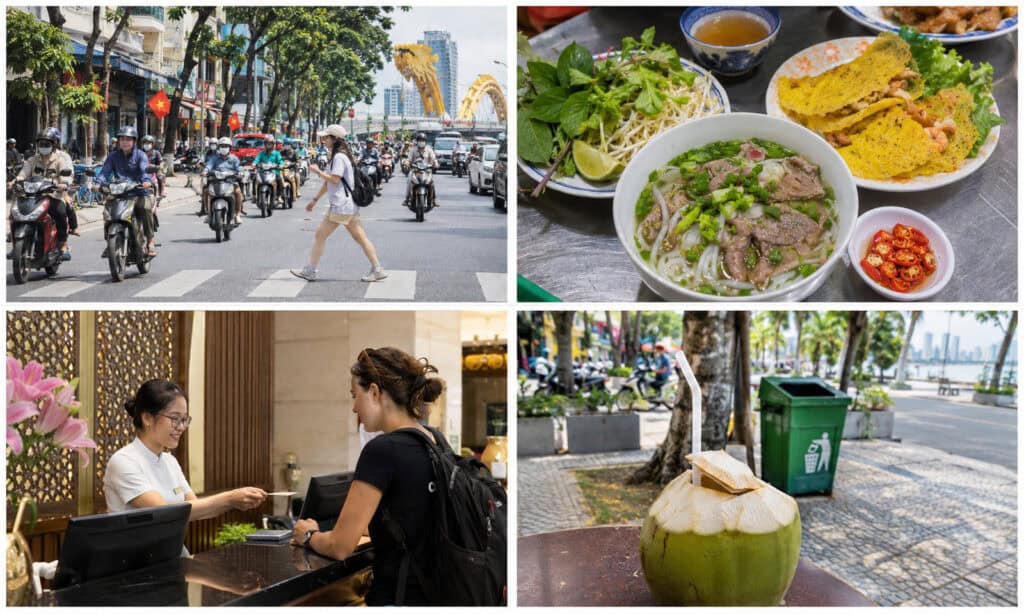
Crossing the Road in Vietnam — My Personal Extreme Sport.
I’ve lived in Da Nang for quite some time, and crossing a busy road still terrifies me. Not slightly nervous. Not a little uncomfortable. Absolutely terrified.
Normally, David helps me negotiate the traffic, but occasionally the poor man has other things to do, and I’m forced to put on my big girl pants and fend for myself.
One day, I needed to cross a particularly busy road to meet a friend for lunch at the beach. I stood on the footpath watching what seemed like several thousand motorbikes appearing from every possible direction. The sweat started running down my face, my heart was racing, and I seriously considered whether lunch was worth risking my life for.
Now, I have another little problem. I’ve had two knee replacements, and although they work reasonably well, climbing over the high concrete median strips in the middle of some Vietnamese roads is simply not an option.
So I’ve developed my own rather unconventional system. I borrow a Vietnamese person. Yes, really.
I find someone who is also crossing the road and attach myself to them. Sometimes I hold their hand, sometimes I put a hand on their shoulder, and off we go. I’ve received some very strange looks, quite a few laughs and plenty of lovely smiles. But nobody has ever refused to help me.
Once we reach the middle, I have to negotiate my way around the end of the dreaded median strip. Then comes part two of the operation. If my original human escort is still around, wonderful. If not, I find another unsuspecting volunteer. Essentially, I’ve turned crossing a road into a relay race, with me as the baton.
And somehow, I usually arrive on the other side in one piece, although possibly requiring a stiff drink.
What always amazes me is the kindness of the people who help me. They don’t know me, they don’t speak my language, and yet they happily assist this slightly panicked Australian woman across the road. It’s one of the things I love about living here.
I may never completely master crossing Vietnamese roads, but at least I’ve learnt that asking for help is considerably more productive than standing on the footpath complaining about the traffic.
Although, if Da Nang ever introduces a personal escort service for terrified pedestrians, I’ll be their first customer.
Cultural Differences Are Part of the Adventure — Even When Pizza Is Involved
One of the great pleasures of travelling is discovering how differently people live. Different food, customs, traditions, languages and ways of doing things. That’s the whole point, surely.
Yet some travellers seem genuinely offended when another country doesn’t operate exactly like home. Take food, for example.
We have a lovely group of expats here in Da Nang who get together once a week to try a different restaurant. It might be a little phở stall on the footpath or a fancy Michelin-starred restaurant. Some meals are wonderful, others perhaps not quite so memorable, but that’s part of the adventure.
However, I must confess that recently there’s been a small rebellion within the ranks. A breakaway group has formed. Their mission. To find the best pizza in Da Nang.
Yes, after all our enthusiasm for embracing Vietnamese cuisine, apparently some of us are suffering from a serious shortage of melted cheese. And I’m certainly not judging. Sometimes I’d give anything for a good old-fashioned Aussie meat pie.
There’s absolutely nothing wrong with enjoying familiar food when you travel. Nor is there anything wrong with deciding that the local speciality you’ve just ordered isn’t something you’d care to repeat.
The difference is how you react. You can politely decide that something isn’t for you without announcing to the entire restaurant that their food is dreadful. And you can enjoy a pizza without expecting every Vietnamese restaurant to have one on the menu. Being open-minded doesn’t mean you have to love everything. It simply means being willing to try.
Bad Tourist Behaviour — The One-Dollar Hotel Drama
Now, let me tell you about something I witnessed recently in Bali. A couple were checking out of their hotel, and the Balinese receptionist was lovely, smiling politely and asking in her best English whether they’d enjoyed their stay.
Everything was going perfectly well. Until the bill arrived. The gentleman wanted to pay with his debit card and was informed there would be a two per cent surcharge.
Well! You would have thought she’d asked him to donate a kidney. He went from a perfectly calm tourist to a ranting, raving performance worthy of a standing ovation. It’s my money. Why should I pay extra
The poor receptionist tried to explain that the charge was related to the bank’s processing fees and not the hotels policy.
He wasn’t listening. The manager was called and attempted to explain the same thing.Still no luck. Now, I’ve occasionally been accused of putting my mouth into gear before engaging my brain. This was one of those occasions.
I politely pointed out that the staff were explaining the charge rather than inventing it just to annoy him. That did not go well at all. I decided retreat was the sensible option.
Eventually, he paid, but not before promising to leave the hotel a dreadful review. A few minutes later, I saw him again, still thoroughly worked up about the injustice of it all. So I walked over, handed him an Australian one-dollar coin and smiled.
He looked at me, completely confused. What’s this for? That’s the amount you’ve just been arguing about. And I walked away. Behind the reception desk, the lovely Balinese staff were trying desperately not to laugh.
Now, I’m not suggesting travellers shouldn’t question unexpected charges. Of course they should. And if a fee hasn’t been properly disclosed, there’s every reason to ask about it. But there’s a difference between questioning a charge and treating the person behind the counter as though they’ve personally committed an international financial crime. Especially when the argument is over roughly a dollar.
The Coconut That Couldn’t Quite Make It Into the Bin
One of the things I really appreciate about where we live in Da Nang is the effort that goes into keeping our street clean. Our rubbish is collected every single day, rain or shine. Local businesses sweep and hose down the footpaths, clean around the bins and generally take pride in keeping the area looking lovely.
And then along comes someone who clearly didn’t get the memo. Recently, I was sitting outside our building enjoying one of my favourite pastimes: people-watching. A woman had bought herself a fresh coconut to drink. Very tropical. Very healthy. Very Instagram-worthy.
When she’d finished, she walked over to the nearby rubbish bin. Excellent, I thought. Someone doing the right thing. Well, almost. Instead of opening the lid and putting the empty coconut inside, she simply placed it on top of the bin and walked away.
I sat there staring in disbelief. The bin was right there. She’d already made the effort to walk over to it. All that remained was the apparently exhausting task of lifting the lid. There was even a tap beside the bin where she could have washed her hands afterwards.
But no. Apparently, the coconut deserved a penthouse suite rather than a place inside the bin. Now, I realise this isn’t exactly an international incident. But it really annoyed me. Every day, local people work hard to keep our street clean, and someone couldn’t be bothered completing the last five seconds of the job.
Perhaps the bin lid was just one cultural experience too many.
Sometimes being a respectful traveller isn’t about understanding complicated traditions or learning another language. Sometimes it’s simply about having enough consideration to put your rubbish where it belongs.
The Great Toilet Emergency
Another experience that has stayed with me happened when I organised a group excursion to Vietnam’s Demilitarised Zone, better known as the DMZ.
I spent weeks planning the trip. I’d arranged a lovely luxury van, an excellent driver I knew and a carefully organised itinerary. Everyone received information about where we were going, what to expect and when we’d be stopping.
I’d even planned the meal stops and bathroom breaks, taking particular care to make sure our driver had opportunities to rest. I thought I’d covered everything. Silly me.
We were travelling along quite happily when a voice from the back of the van announced that she needed the toilet. Let’s call her Jane. I explained that we had another scheduled stop coming up in about twenty minutes.
That wasn’t good enough. A few minutes later, the request became rather more demanding. We need to stop. Our driver explained that there was somewhere closer, but it only had traditional toilets. I passed on the information and asked whether she could wait until the planned stop.
The answer was a very firm and rather rude no. So we stopped. Jane was first out of the van and headed straight into the toilets. Seconds later, she reappeared, making it very clear that she wouldn’t be using those facilities.
They were squat toilets, and the smell wasn’t exactly that of a luxury hotel bathroom. Now, with my two replacement knees, I am probably the last person on earth who should criticise someone for being unable to use a squat toilet. I completely understand that problem.
What I didn’t appreciate was the demanding manner, the dismissive attitude towards perfectly normal local facilities and the lack of consideration for everyone else, including our Vietnamese driver.
So back into the van we went. About ten minutes later, we reached our originally planned stop, complete with clean Western-style toilets. Crisis over.
Although I must confess that, as Jane was the only smoker in the group, a small and rather suspicious part of me wondered whether the emergency might have involved a cigarette. I have absolutely no proof of that. But after spending weeks planning everybody’s toilet breaks, I reserve the right to have the occasional uncharitable thought.
The experience reminded me that we can all have genuine difficulties with unfamiliar facilities. But how we handle those difficulties, and how we treat the people trying to help us, says a great deal about our manners.
Good Travel Etiquette Doesn’t Require Perfection
Living overseas has taught me that respectful travel isn’t about memorising hundreds of complicated rules. It’s often about something much simpler. Patience, courtesy and accepting that different doesn’t automatically mean wrong.
I’ve watched tourists become increasingly frustrated when someone doesn’t understand their English. And what do they do? Repeat exactly the same sentence, only louder. Apparently, increasing the volume is now an internationally recognised translation service. Really.
I volunteer teaching English to university students in Da Nang, and I see how much effort many young Vietnamese people put into learning another language. It makes me wonder how many visitors make the effort to learn even a few words before arriving in a foreign country.
My own Vietnamese pronunciation has provided more than enough entertainment over the years, so I’m certainly not claiming perfection. But trying matters. A smile, a little patience and a willingness to laugh at yourself can achieve an enormous amount. And sometimes, the best thing you can do when travelling is stop talking and start observing.
After all these years living overseas, I still haven’t mastered crossing a Vietnamese road without recruiting an unsuspecting local. So I’m hardly in a position to lecture anyone about being the perfect traveller.
And believe me, I’ve had my moments. I’ve been hot, tired, frustrated and occasionally ready to pack my bags and head somewhere that serves a decent Aussie meat pie.
But I’ve also experienced extraordinary kindness from complete strangers, laughed at misunderstandings and discovered that some of my favourite travel memories came from things that went completely wrong.
I’ve learnt that you don’t have to love everything about a country to appreciate it. And you certainly don’t have to understand everything to show a little respect.
The world is full of fascinating people, wonderful traditions and ways of living that are completely different from our own.
What a boring place it would be if everyone did things exactly the same way.
So travel wherever you like. Enjoy your five-star hotels, your local street food or even your familiar pizza. Just remember that you’re visiting someone else’s home. And perhaps, before criticising everything that’s different, ask yourself whether it’s really the country that needs to change.
Your passport may be full of stamps. But if your mind never left home, what was the point of going?
Love MyLifestyle #Sheridan-Leigh
Read my personal journal stories here.
About the Author:
Sheridan-Leigh is the passionate voice behind the MyLifestyle Blog, where life is celebrated with vibrant stories and insightful travel tips. With a deep love for slow travel, she believes in truly experiencing each destination, creating connections beyond the surface. Her blog is a blend of personal stories, expert advice, and a philosophy that life is for living to the fullest and is rich with opportunities for growth and adventure. Join Sheridan-Leigh as she shares her journey, inspiring others to embrace life, travel deeply, and live fully.