

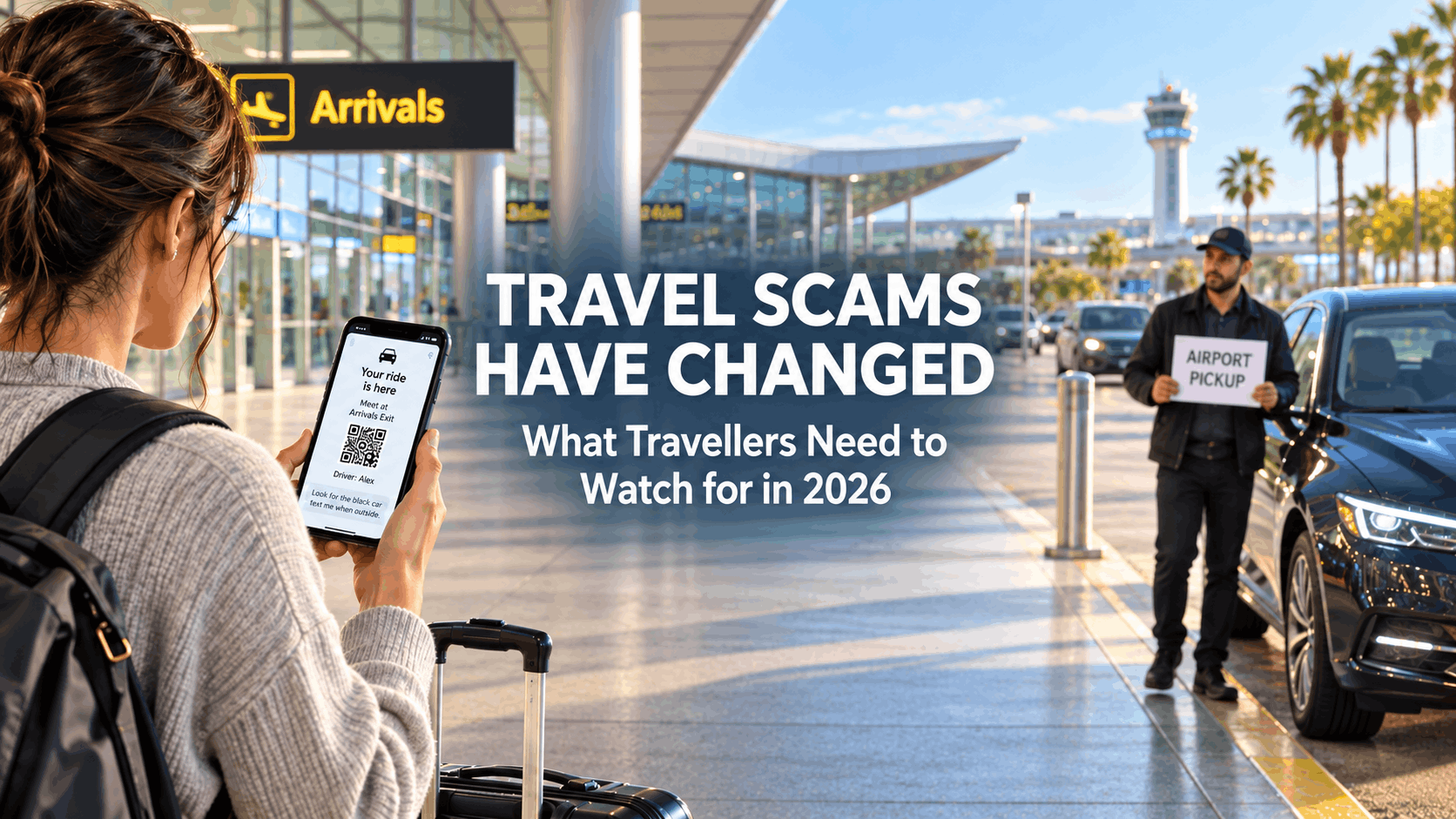
Travel Scams Have Changed
What Travellers Need to Watch for in 2026
Modern travel scams can look like genuine booking messages, official QR codes and helpful airport drivers. Knowing the warning signs matters, but so does recognising when tiredness and urgency are affecting our judgement.
Travelling has always required a little common sense. We keep an eye on our bags, check the taxi fare and avoid changing money with a stranger in the street. But travel scams in 2026 are not always as easy to recognise.
A fake message may contain the correct hotel name, travel dates and booking number. A fraudulent website can look almost identical to the real one. Someone approaching at an airport may appear at exactly the moment we expect our driver to arrive.
Artificial intelligence has not invented travel fraud, but it has made polished emails, realistic images and natural-sounding messages easier to produce. At the same time, our phones now hold our bookings, maps, banking, passport copies and travel apps. One hurried decision can affect far more than a single reservation.
I understood all of this. I used to teach cybersecurity, and my husband speaks publicly about artificial intelligence. Between us, I thought we were reasonably knowledgeable about scams and the many ways people can be deceived.
Then, on a trip to China, I discovered that knowledge does not make any of us immune.

The Airport Driver Who Was Not Our Driver
We were finishing a cruise in Shanghai when heavy sea fog forced the ship to slow down for safety. We arrived in port many hours later than expected.
I was not particularly concerned. I had prepaid for a driver to collect us from the cruise terminal and assumed he would know that the ship had been delayed. Surely cruise ships arriving late was not an unusual event.
After what seemed like forever, we cleared immigration and walked out of the terminal. It was around two o’clock in the morning. The driver I had booked was not answering my WhatsApp messages, but even then, I was not overly worried. I had made the booking through a reputable travel website that I knew well and was affiliated with, so I assumed everything would be sorted out.
After a few minutes, a man approached us and said, Sorry, I am here. That was all it took. I did not ask his name, which company he worked for or whether he could confirm my booking. At two o’clock in the morning, after a long delay and an exhausting trip through immigration, he said exactly what I wanted to hear.
He led us to an old, battered car. That should have rung an alarm bell, but our luggage was loaded into the boot and we climbed into the back seat. He then asked which hotel we were going to. A prepaid driver should already have known our destination, yet I told him and we set off.
About a kilometre from the terminal, he pulled into a dark area, stopped the car and demanded money. I explained that we had already paid. He insisted that we had not and refused to continue unless we paid him.
We had only just arrived in China and did not have any yuan. All we had was some US currency, and the exchange rate he offered was certainly not one any bank would have recognised. But it was the middle of the night, we were sitting in a stranger’s car in an unfamiliar place, and our luggage was locked in his boot. We paid.
Eventually, he drove us to the hotel. By then, I was less concerned about the money than relieved that we had arrived safely. The following day, the original booking company told me that because the ship was late and no revised arrival time had been provided, our driver had cancelled the pickup. There would be no refund. We could try claiming through our travel insurance.
We had paid twice for the same journey once for the legitimate driver who did not wait and again for the stranger who found two tired travellers outside a cruise terminal at two o’clock in the morning.
Looking back, the warning signs seem obvious. He did not know our names, booking details or hotel. I knew the usual advice I simply did not follow it. He succeeded because he appeared at the exact moment when we desperately wanted him to be our driver.
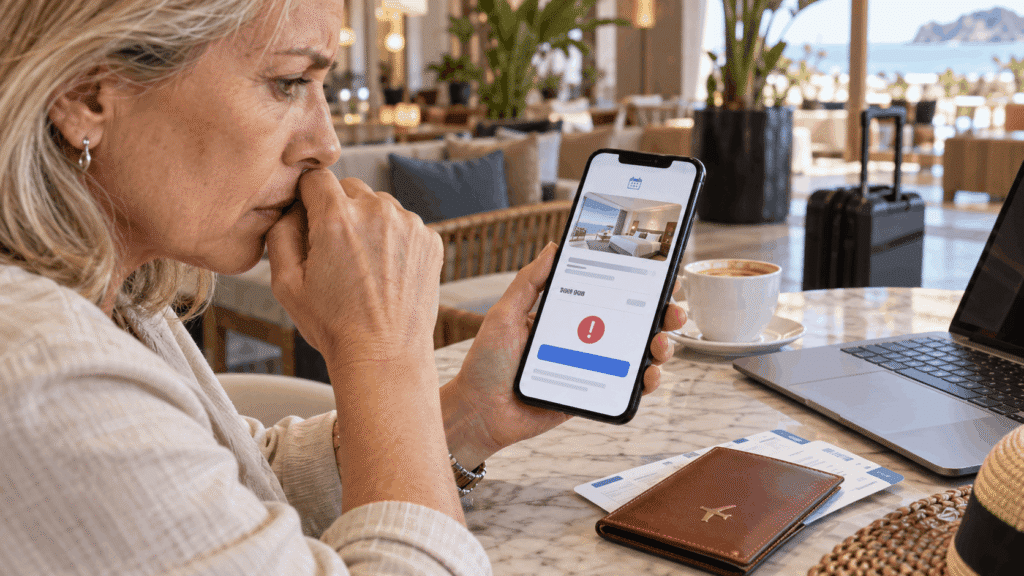
Fake Booking Messages and Accommodation Scams
The Shanghai experience involved an impostor in person. Many modern travel scams begin with a message that appears to come from a company we already trust.
Imagine receiving an email a few days before arrival. It names your accommodation, confirms the correct dates and warns that your card has been declined. Unless you verify the payment immediately, your reservation may be cancelled. The thought of arriving without a room creates exactly the urgency the scammer needs.
Do not use the link in the message. Open the booking app yourself or type the company’s known address into your browser. Check whether the same request appears inside your account. If necessary, contact the hotel using a phone number found independently.
Fake accommodation listings can be equally convincing because the photographs may be genuine. They may simply have been copied from another property or an old listing. Warning signs include an unusually low price, pressure to pay by bank transfer and requests to move the conversation away from the recognised booking platform.
After years of booking accommodation across Southeast Asia, I no longer judge a property by its best photographs or its lowest price. I read recent reviews, including the poor ones. A five-star review may praise the view; a one-star review may reveal that there is no lift, the street floods or construction begins next door at seven in the morning.
I also check the address on a map, look at photographs uploaded by guests and contact the property if I am staying for more than a few nights. How and whether they respond can tell me quite a lot. A bargain is only a bargain if the accommodation is genuine, suitable and somewhere I would actually want to stay.
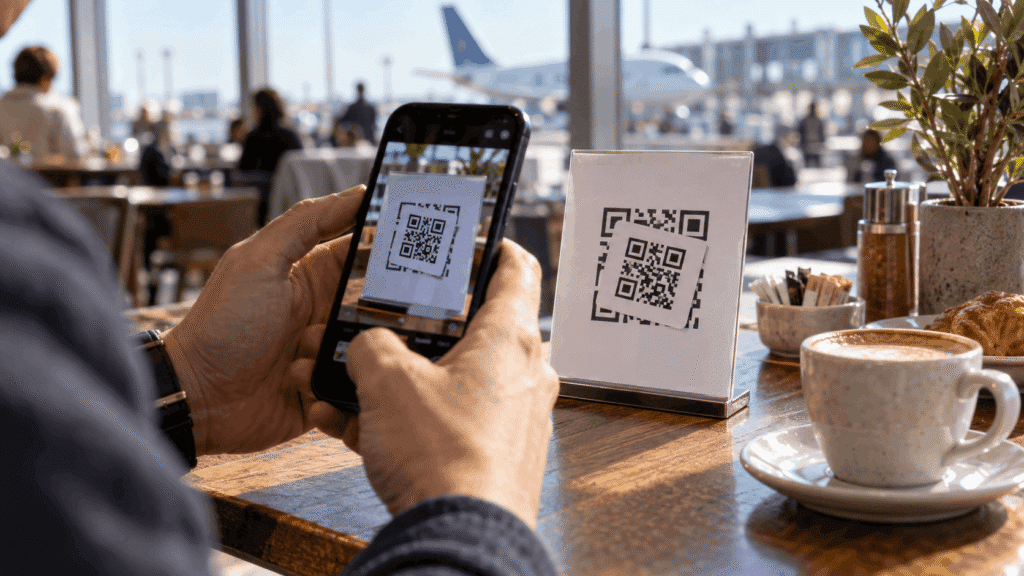
QR Codes Public Wi Fi and Digital Traps
QR codes are now used for menus, tickets, payments, parking and hotel information. Most are legitimate, but a scammer can place a sticker over a real code or create one that leads to a copied payment page.
Before continuing, look at the web address displayed by the phone. Be cautious if a menu or information code suddenly asks for card details, a password, an app download or a small payment. A QR code is only a shortcut to a website. It is not proof that the website is safe.
Public Wi-Fi creates a similar problem. Anyone can create a network with a convincing name such as Airport Free WiFi or Hotel Guest Network. Ask staff for the correct network name and avoid opening banking apps or entering card details on an unfamiliar connection. Mobile data or a personal hotspot is the safer choice for anything sensitive.
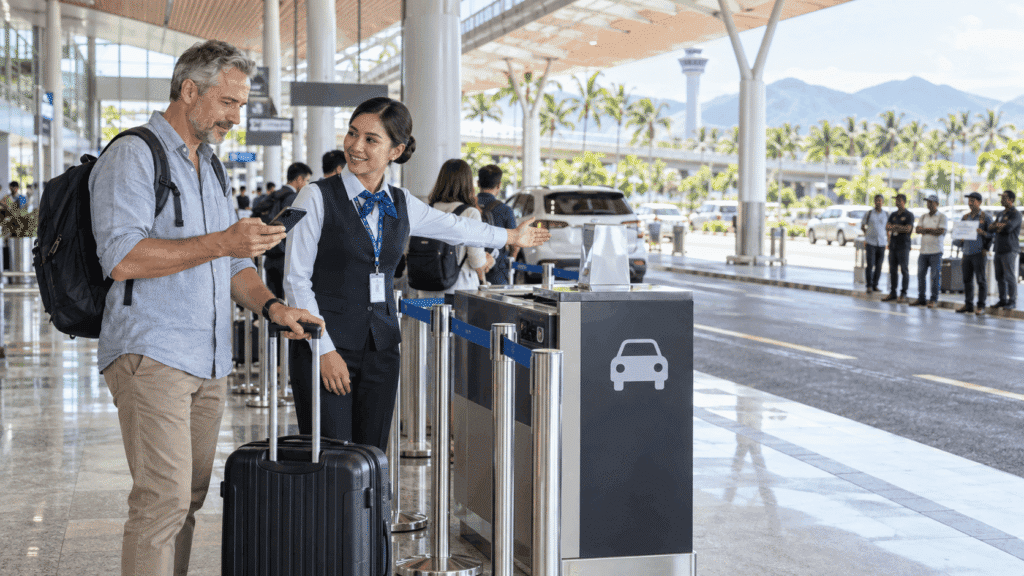
Fake Rideshare Drivers and Airport Taxi Scams
Airports are ideal places for fake rideshare and taxi drivers. Arriving passengers are tired, carrying luggage and trying to identify the right vehicle in a busy pickup area.
Always compare the registration, vehicle and driver photograph with the details shown in the app. Ask the driver to confirm the passenger’s name rather than offering it first. Do not cancel an app booking and pay privately because someone promises a better price.
Da Nang International Airport now has a designated rideshare pickup area staffed 24 hours a day. You book through the Grab app, walk to the marked area and wait for the car shown on your phone. An attendant is available if there is a problem, and passengers can avoid the unofficial Grab drivers waiting near the terminal entrance.
A friend who came to visit us learned why this matters. Before he arrived, I explained exactly what to do book through the app, walk to the designated pickup area and ignore anyone approaching him inside the terminal.
He followed none of those instructions. A driver met him near the entrance, claimed to be a Grab driver and offered to take him to our apartment for 500,000 dong. My friend agreed and arrived safely.
The problem was the price. The same journey through the Grab app would have cost approximately 90,000 dong. He paid more than five times the usual fare, not because the app had failed, but because he never used it.
Fortunately, the only thing injured was his wallet. He has since learned that when I give detailed airport instructions, there is usually a reason.
ATM and Card Payment Scams
Some of the oldest travel scams still work. Use ATMs attached to a bank or located in a secure, well-lit area. Check whether the card slot or keypad appears loose, damaged or covered by an added piece. Shield your PIN and do not accept help from a stranger who says the machine requires a special procedure.
When a terminal offers to convert a purchase into Australian dollars, pause before accepting. Paying in the local currency will often allow your own bank or card provider to perform the conversion, although fees vary.
Carry at least two payment methods and keep them separately. If one card is blocked, lost or retained by a machine, you will still have a way to pay for transport or accommodation.
How AI Makes Travel Scams Harder to Spot
We used to be told that poor spelling and awkward language were obvious signs of a scam. That advice is no longer reliable.
Generative AI can produce fluent messages in many languages, copy the tone of customer-service correspondence and alter images. Details collected from a public social-media post may make a message appear personal and believable.
Judge the request rather than the quality of the writing. Is someone asking for money, a password, a verification code or urgent action? Can the request be confirmed through an independent channel? Good spelling proves nothing; verification matters more than appearance.
What to Do If You Have Been Scammed
Embarrassment is one of a scammer’s most useful allies. Intelligent and experienced people are caught because the approach arrives at the right moment. Acting quickly matters more than blaming yourself.
- Contact your bank immediately. Ask it to stop or dispute the transaction and block or replace the affected card.
- Change compromised passwords. Use a trusted device, change any account using the same password and turn on multi-factor authentication.
- Secure a lost or stolen phone. Use the manufacturer’s official location and remote-lock service, then contact your mobile provider.
- Protect your booking account. Contact the platform through its official app or website and preserve screenshots of suspicious messages.
- Report the incident. Australians can report scams to Scamwatch and cybercrime through ReportCyber. If a passport is missing, contact the nearest Australian embassy or consulate through Smartraveller.
Before You Travel Security Checklist
- Update your phone, tablet and laptop before departure.
- Use strong, different passwords for your main email and booking accounts.
- Turn on multi-factor authentication wherever possible.
- Save your bank’s international contact number somewhere other than on the card.
- Keep secure copies of your passport, insurance, prescriptions and bookings.
- Carry two payment methods and store them separately.
- Download essential maps, addresses and booking details for offline use.
- Use official apps and independently check unexpected payment requests.
Travel Confidently but Stop and Check
Years of travel have not made me frightened or suspicious of everyone I meet. If anything, they have made me more confident. Most people are honest, most drivers simply want to do their job and most travel problems can be resolved.
But confidence should never become complacency.
My experience in Shanghai taught me that knowing about scams is not the same as recognising one when you are tired, confused and standing in an unfamiliar place at two o’clock in the morning. Sometimes we see the warning signs and ignore them because we desperately want everything to be all right.
I still trust people, use travel apps and explore unfamiliar places. I have simply learned to pause when something does not make sense. Open the official app. Call a number found independently. Check the registration plate and read the web address before entering anything.
A few questions or a quick check may delay me by five minutes. That is a small price to pay compared with discovering that the person, booking or payment request I trusted was never genuine in the first place.
About the Author:
Sheridan-Leigh is the passionate voice behind the MyLifestyle Blog, where life is celebrated with vibrant stories and insightful travel tips. With a deep love for slow travel, she believes in truly experiencing each destination, creating connections beyond the surface. Her blog is a blend of personal stories, expert advice, and a philosophy that life is for living to the fullest and is rich with opportunities for growth and adventure. Join Sheridan-Leigh as she shares her journey, inspiring others to embrace life, travel deeply, and live fully.
Alternatively, view the full interactive travel journey at MyLifestyle Travel Map
Click on a trip line to see images, posts, accommodation and travel information about the destinations.
See her recent travels: Click on the image. https://mylifestyle.travelmap.net